
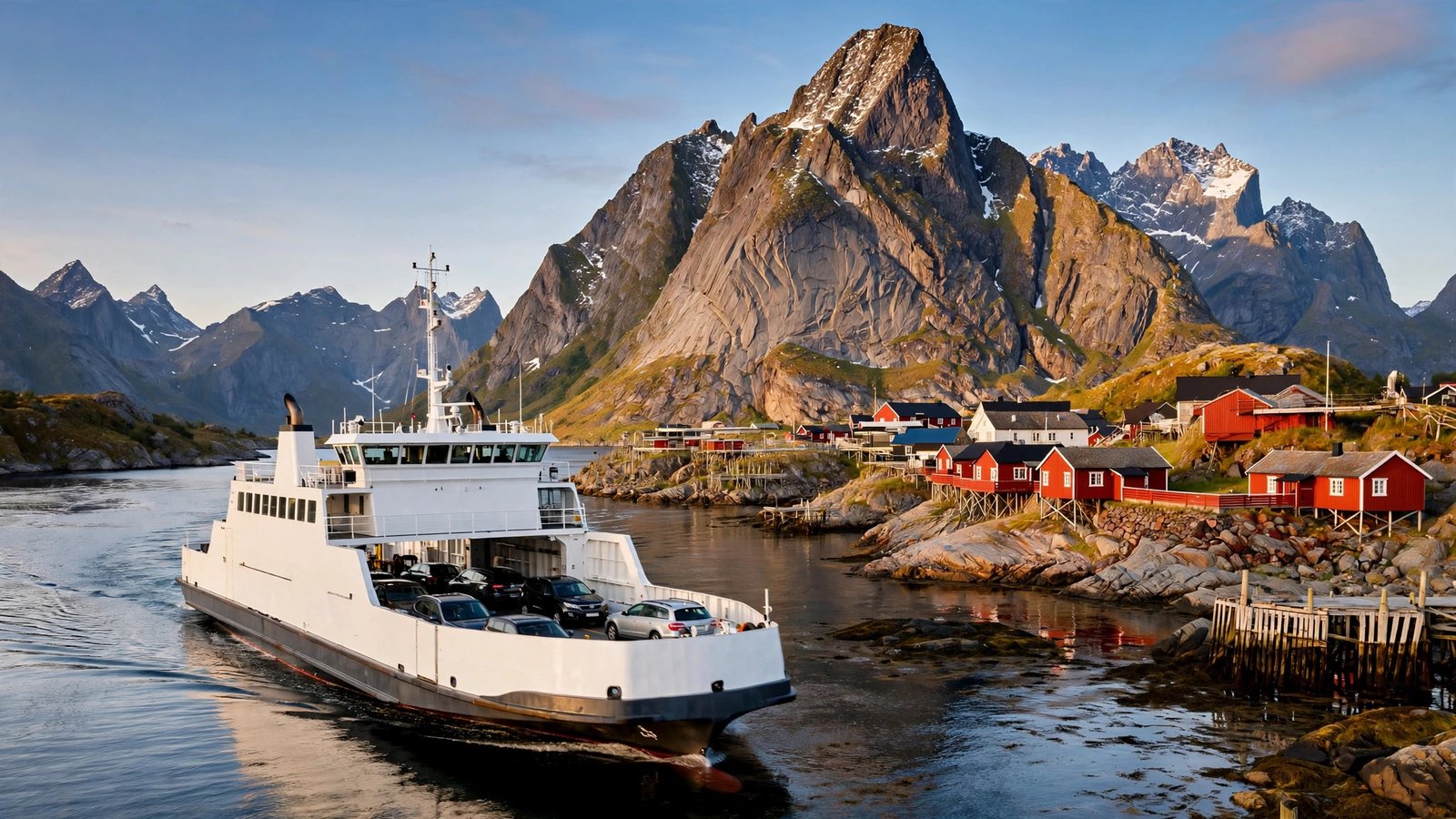
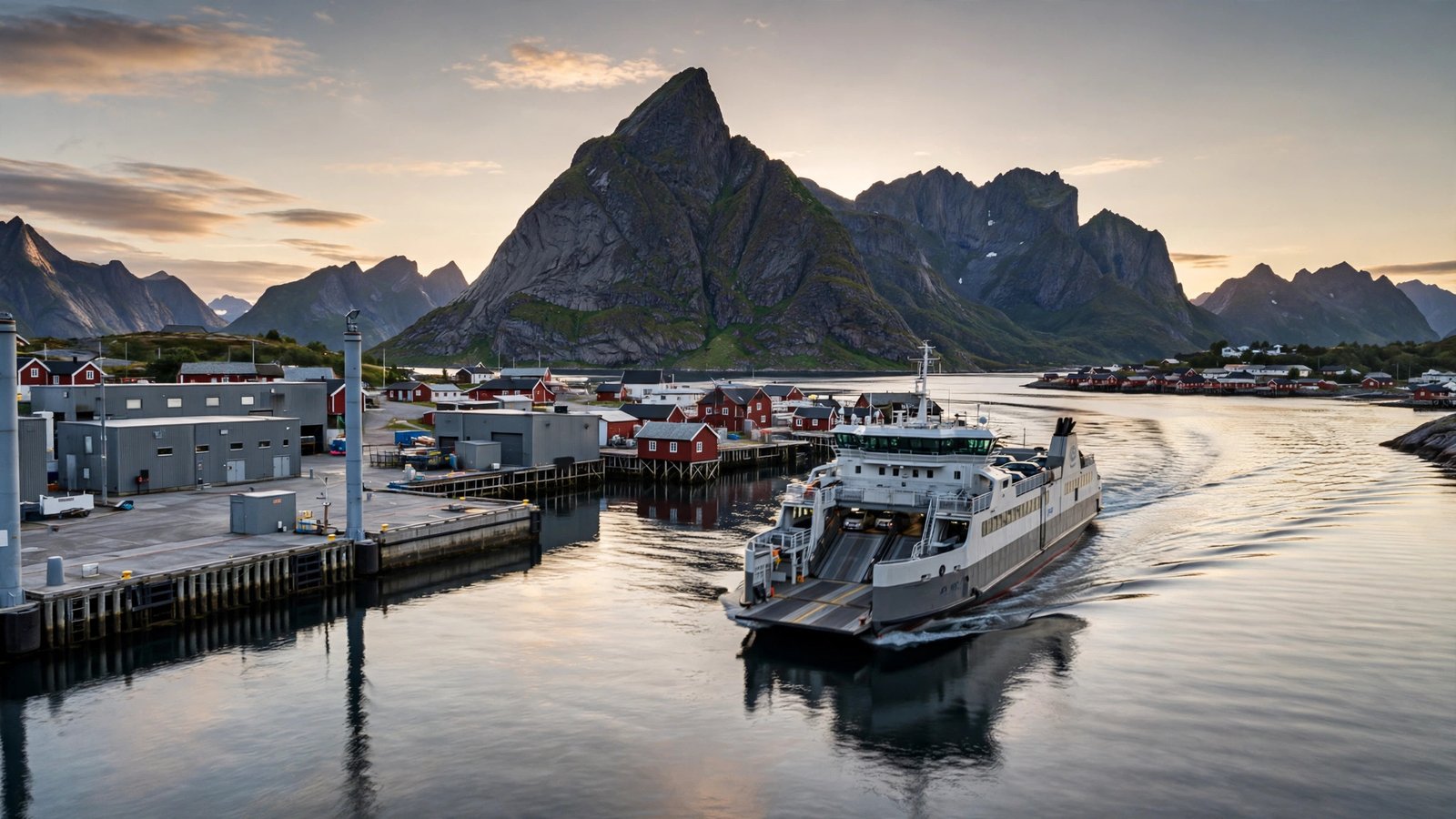
The bodo to moskenes ferry is more than transport — for generations it has been the way to arrive in Lofoten. You board in the mainland city of Bodø, cross the wide Vestfjord for about three and a half hours, and watch the Lofoten Wall grow from a smudge on the horizon into a wall of granite peaks, until the ferry slides into Moskenes harbor a few minutes from Reine. Travelers who have done it both ways tend to keep a loyalty: the plane is faster, but the ferry is an arrival.
This guide covers the crossing itself — tickets, cars, seasons and rough weather — then the other ferries that stitch the islands together, and finally how to tour Lofoten without a car at all. It sits inside our wider route comparison, how to get to Lofoten Islands, and assumes you have read the basics there.
The Bodo to Moskenes Ferry Crossing
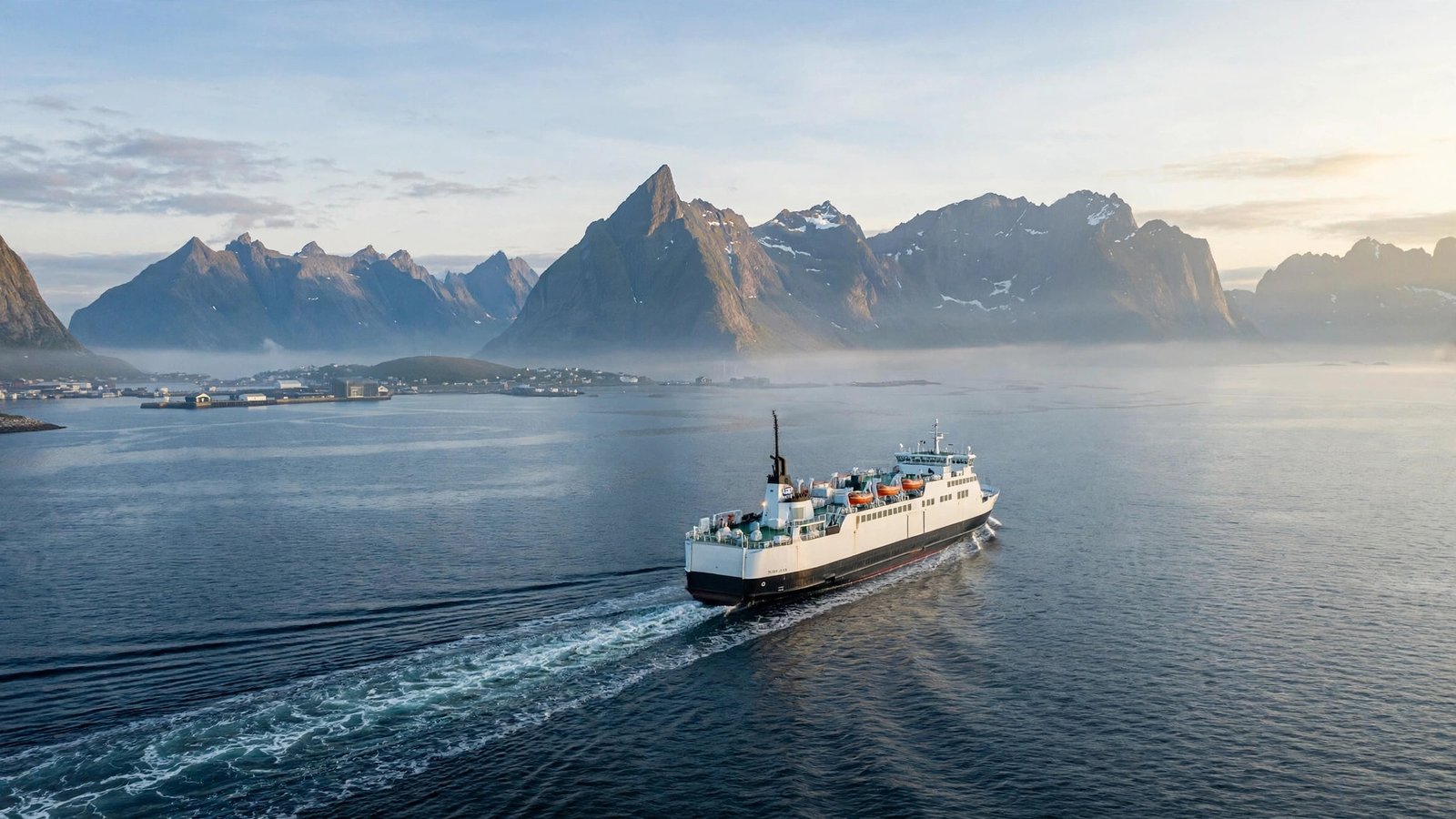
The route is operated by Torghatten Nord, the ferry company for this stretch of coast, and runs year-round with a timetable that breathes with the seasons: multiple daily departures in the summer peak, fewer in the dark months, and typically at least one well-timed departure for the main travel flows in between. The crossing takes roughly 3 hours 15 minutes to 4 hours depending on the sailing and conditions; some sailings route via the bird islands of Røst and Værøy, which lengthens the trip but turns it into a sightseeing cruise in its own right.
On board you get the Norwegian ferry standard, which is better than visitors expect: a comfortable lounge with big windows, a café serving coffee, waffles and simple hot food, outdoor deck space for the arrival views, and — on the direct summer sailings — a steady commentary of mountains. The last half hour, as the ferry closes with Moskenesøya’s peaks and the harbor at Sørvågen and Moskenes comes into focus, is the part nobody sleeps through.
Two pieces of officialdom matter: book vehicles and check the live timetable on the operator’s site, Torghatten Nord, before you travel — schedules change seasonally and occasionally at short notice in bad weather; and note that the ferry terminal in Bodø sits a short walk or quick bus ride from Bodø station and the airport bus stop, so train-to-ferry connections are easy to make on foot.
Tickets, Cars and Booking Rules
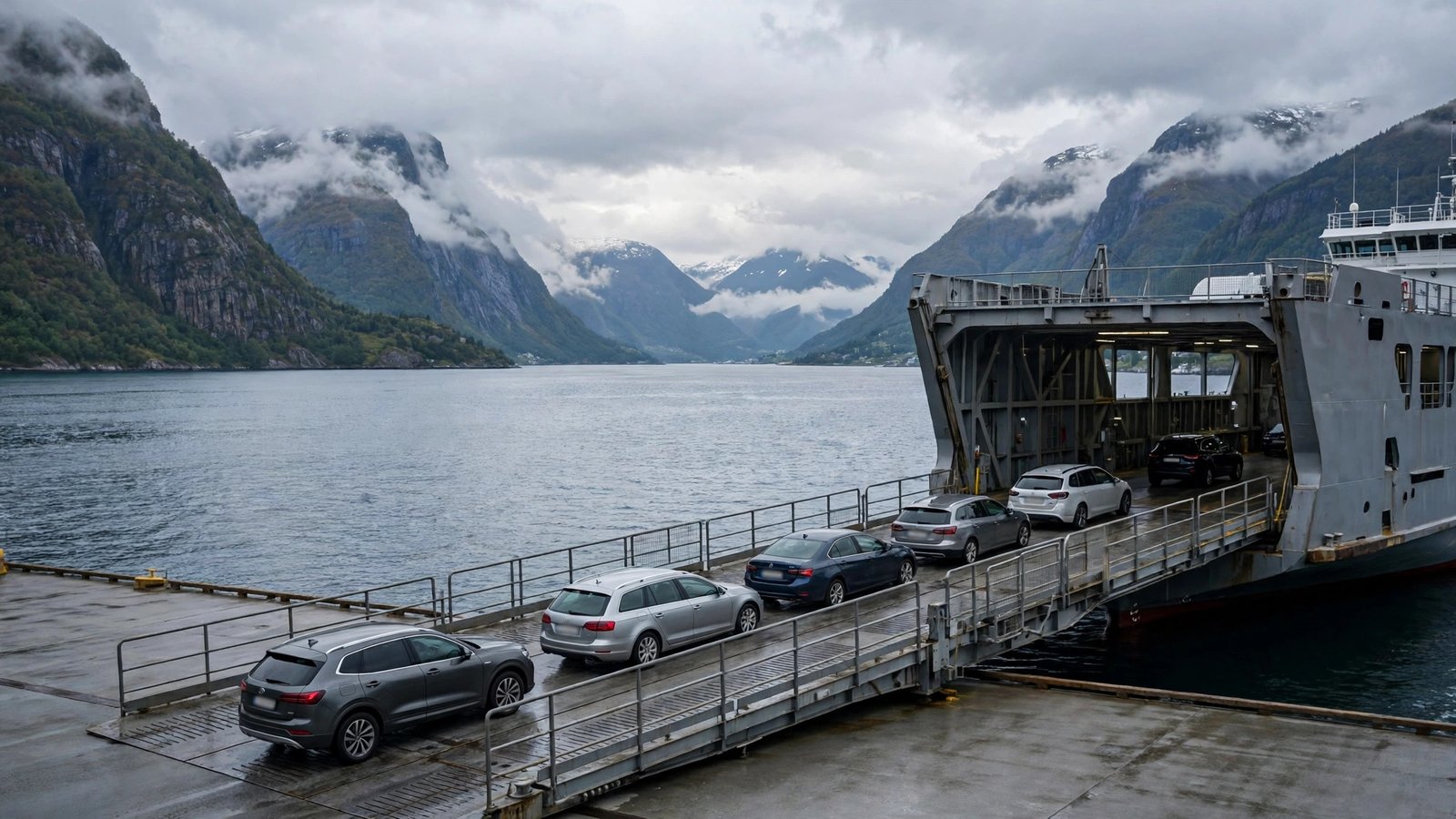
The ferry’s pricing has a feature visitors love: foot passengers travel free on this route — you simply walk aboard. You pay for the vehicle, with the fare depending on the vehicle’s size, and for any optional extras. That single fact shapes Lofoten trip economics: a couple on foot pays nothing for the crossing itself, while a car pays a real fare — which is why the comparison between “car on the ferry” and “rent in Lofoten” is worth doing with actual numbers for your dates, and why you should check current prices at booking time rather than trusting any guide’s figures, including this one.
Vehicles are the scarce resource. In the summer season, drive-up space sells out on popular sailings, and the operator runs a reservation system for cars — book your vehicle space as soon as your dates are set, particularly for Friday and Sunday sailings and the whole of July. Foot passengers, cyclists and (usually) motorcyclists can travel unbooked, though arriving early at peak times is still wise.
Check-in discipline: vehicles must typically arrive well before departure (the operator’s booking confirmation states the exact cutoff — respect it, because standby queues in July are long and the ferry does not wait). If your reserved sailing is cancelled for weather, your booking rolls to the next available crossing per the operator’s instructions; in high season that can mean hours, which is one more reason the first day in Lofoten should be a soft one.
Rough Weather, Seasons and Cancellations
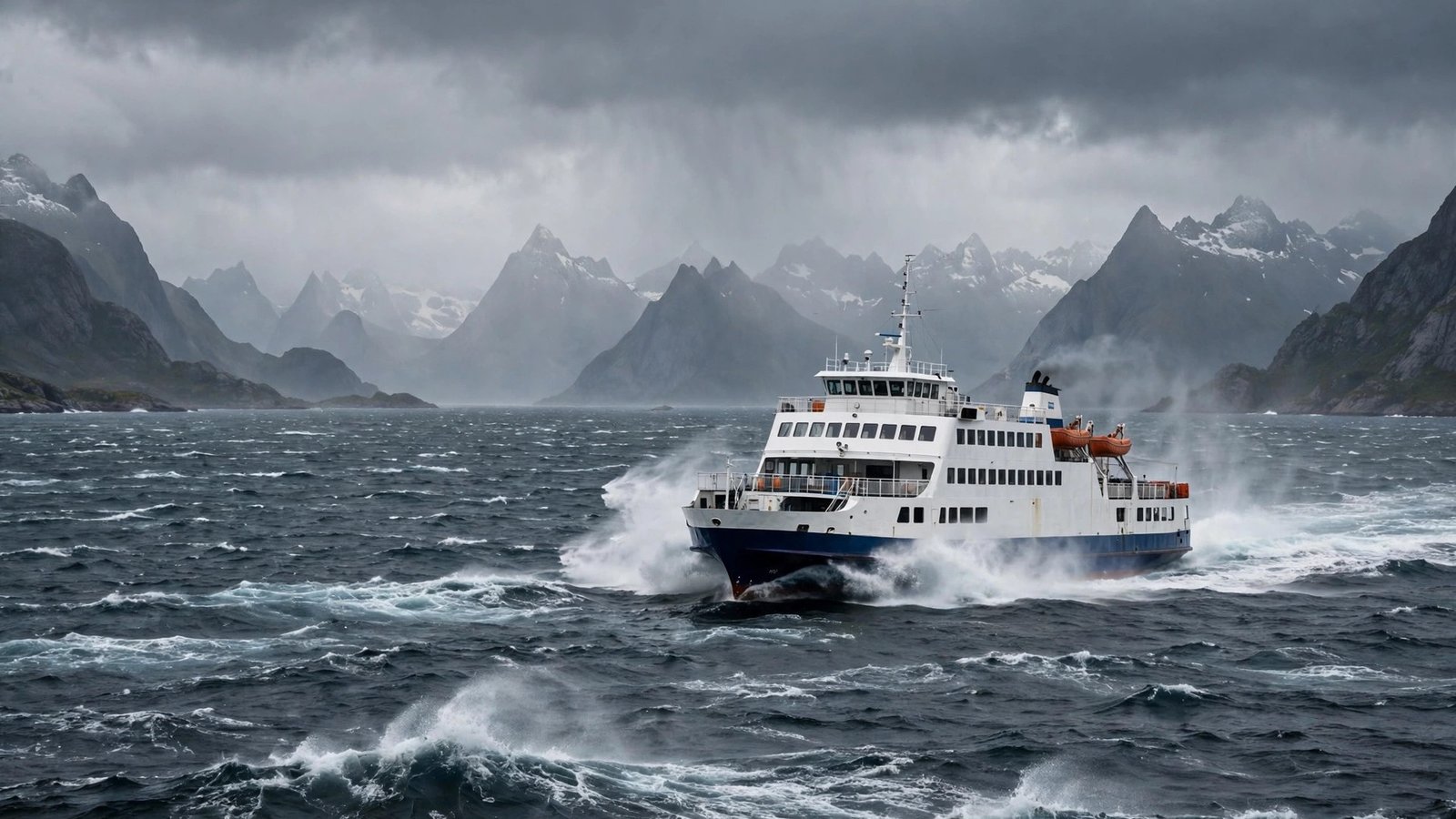
The Vestfjord is open Norwegian Sea, and the crossing has a reputation to match: in strong winds it can be a genuinely rough three hours, and in the worst storms sailings cancel. Practical coping strategies:
- Summer (June–August): the calmest season and the busiest; seasickness is uncommon. The risk is not weather but capacity — book the car early.
- Shoulder seasons: beautiful crossings, lower decks, and the first autumn storms from late September. Keep plans flexible on travel days.
- Winter (November–March): the dramatic season. Crossings run, but cancellations concentrate here, and the sailing may be re-routed or delayed. If you must cross for a flight, cross a day early. If you do sail, a dark Vestfjord with snow peaks lit by the ship’s lights is an Arctic memory — take motion-sickness precautions regardless of your confidence, because this water humbles sailors.
Locals treat the ferry’s weather judgment with respect; if Torghatten cancels, nobody sensible argues. Build the same slack into your itinerary that they build into theirs.
Lofoten Ferry Guide
The Moskenes ferry is the famous one, but Lofoten’s internal ferry web is what makes island-hopping work:
- Reine → Vindstad (for Bunes beach): the small local ferry from Reine across Reinefjord to Vindstad, gateway to the Bunes beach hike — a classic half-day; buy tickets per the local operator’s instructions and mind the return sailing, as there is no road out of Vindstad.
- Svolvær → Skrova → Skutvik: links Lofoten’s capital with the island of Skrova (a half-day of beaches and the whale museum) and onward to the mainland at Skutvik.
- Bognes → Lødingen: the E6 ferry north of Lofoten — the drive-on route between the Bodø region and Evenes/Tromsø without the long inland detour.
- Melbu → Fiskebøl: the short hop between Vesterålen and Lofoten’s northeast, useful for Senja-and-north combinations.
- Bodø → Røst and Værøy: the outer-island extensions of the Moskenes route for birders heading to the puffin colonies (seasonal patterns apply).
- Stamsund and Svolvær local boats: express boats and the coastal ship connect the islands for those building a car-free itinerary (next section).
Timetables for all of these run through the national planner Entur and the operators’ own sites; ferry culture in Norway is “show up, queue, board, pay by card,” with reservations the exception rather than the rule outside the big summer routes.
Getting Around Lofoten Without a Car
It can be done — the islands’ bus network, boats and tours form a workable system if you base well and plan around published timetables rather than improvising. Our honest assessment of the car-free version:
Base in Svolvær. The capital has the airport, the coastal-ship quay, the express boat to Bodø, the best bus connections and the densest tour market (sea-eagle safaris, fishing trips, aurora tours all depart from the harbor). Staying here, most postcard sights are a bus ride or a tour away.
Use the E10 bus spine. Buses run the length of the E10 between Å and the northeast, stopping in the villages this guide keeps mentioning — Reine, Ramberg, Leknes, Kabelvåg, Henningsvær (with a short branch) — at a frequency that rewards planning: a few departures a day rather than an urban rhythm. The villages themselves are made for feet; it is the distances between them that the bus is for. Our Lofoten villages guide is written to be walked, village by village.
Take the express boat for the Bodø leg. The NEX2 catamaran between Bodø and Svolvær (about 3.5 hours) is the car-free traveler’s trunk route, and it doubles as a fjord cruise past the Lofoten Wall.
Book tours as transport. In Lofoten, guided excursions double as the rural transport network: an aurora tour is also your night bus to the dark skies, a Reine day-trip covers the west end, and the RIB safari is also how you see the Trollfjord. Car-free travelers should budget some of the saved rental money for tours and take the best of both.
Taxis and the one strategic rental. Taxis exist in the towns but are a premium tool at Norwegian prices — best saved for airport runs and late arrivals. And many car-free visitors rent a car for just 48 hours in the middle of the trip for the Reine end of the islands, where distances and scenery peak together; combined with a Reine-side stay from our guide to where to stay in Lofoten, this hybrid is the version of car-free Lofoten we recommend most.
The Arrival Itself
One last practical note, because it catches people out: Moskenes is a working harbor, not a transport hub. There is no big terminal, no rental desk row, and on a quiet evening sailing there may be exactly one taxi. If you are being collected, agree the pickup in advance with your accommodation; if you are driving off, the E10 begins at the ramp and Reine is ten minutes away; and if you are on foot, the bus stop is at the harbor — check the connection against your sailing before you board in Bodø, not after you land.
Frequently Asked Questions
How long is the Bodø to Moskenes ferry? About 3.5 hours on the direct sailing; longer on sailings routed via Røst and Værøy. Check the operator’s timetable for your specific departure.
Do foot passengers really travel free? Yes — the route’s longstanding pricing has foot passengers (and cyclists) riding free, with fares charged per vehicle. Confirm the current terms when you book, as transport pricing does change.
What happens if my ferry is cancelled? Vehicle bookings are re-accommodated on later sailings per the operator’s instructions; foot passengers simply take the next crossing. In summer, expect standby queues after a cancellation and protect onward connections accordingly.
Can I reach Reine from Moskenes without a car? Easily — it is about 3 miles. Local buses meet many ferry arrivals for Reine and Å, taxis wait at busy sailings, and in good weather it is a flat, scenic walk or cycle.
Should I take the ferry or fly? If your base is Reine or Å and you are renting a car in Bodø, the ferry is usually the better whole journey: one booking covers the crossing and you arrive mobile. If you are based in Svolvær, short on time, or traveling in the storm-prone weeks, flying to Svolvær or driving from Evenes is the more weather-proof plan. Many regulars do one of each — fly in, sail out — because the Vestfjord crossing in the evening light is worth having in the trip exactly once, and the flight home protects the connection that matters.
The Bottom Line
Sail the bodo to moskenes ferry if your Lofoten is based in the west, book the car space early in summer, respect the Vestfjord’s weather like a local, and treat the crossing as the first chapter of the trip rather than an errand before it. And if you are touring without a car, do not let anyone tell you it cannot be done: base in Svolvær, ride the buses and boats deliberately, and spend the savings on the tours that make Lofoten sing.
