
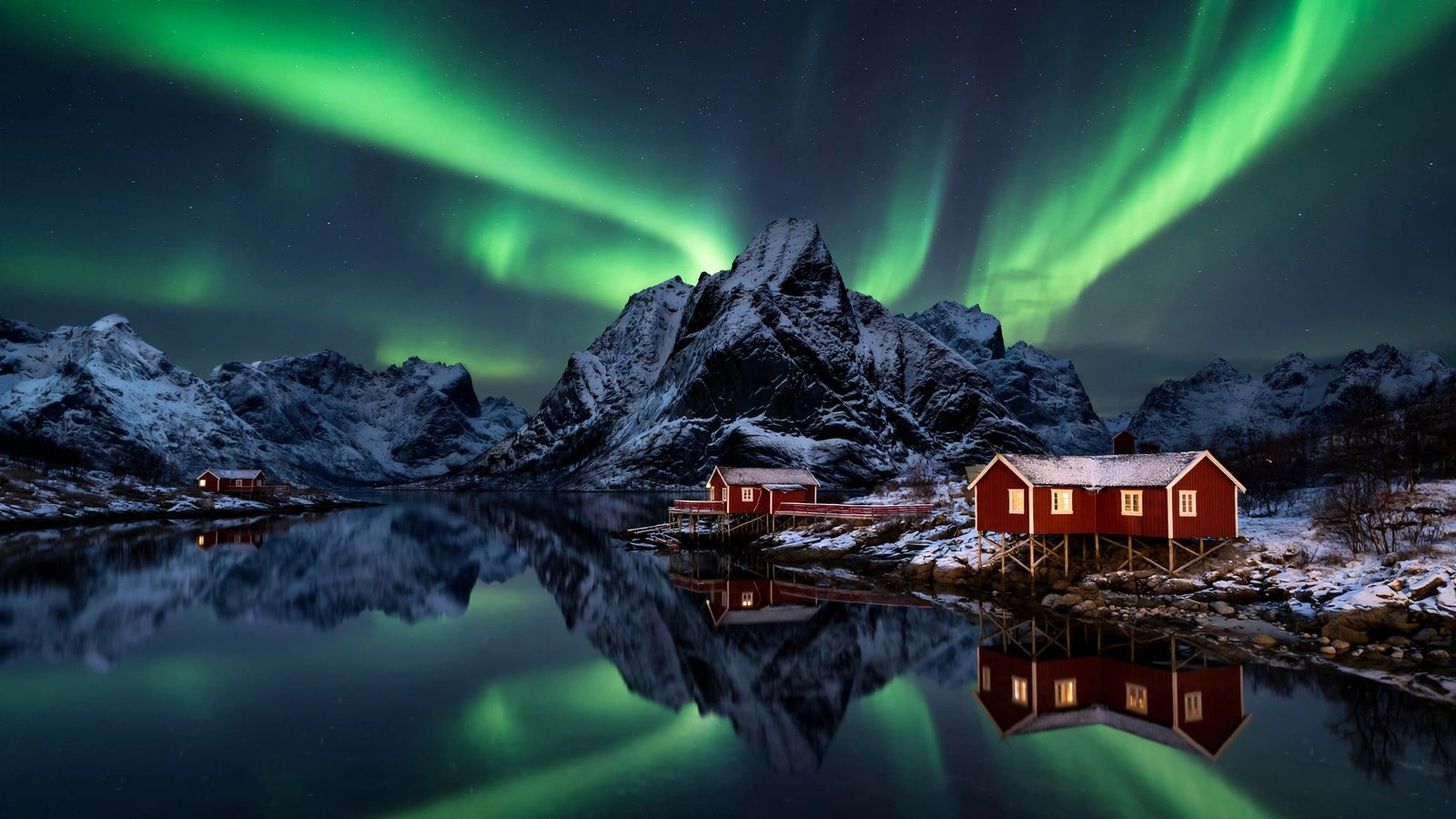
The lofoten islands northern lights are a particular kind of spectacle: not just the aurora itself, but the aurora framed — green arcs over black fjords, reflected in still water, above red cabins and snow-covered granite. Photographers rate Lofoten among the world’s great aurora locations for exactly that combination of sky and foreground. But the islands also deal honestly with their visitors: coastal weather, changeable skies, and a season that rewards patience and punishes tight schedules.
This guide covers the season, the realistic odds and the photography. For the specific viewpoints, our local guide to the aurora watch best spots to see the northern lights maps the locations themselves; here we deal with when, how likely, and how to shoot it.
Northern Lights in Lofoten Season
The aurora season in Lofoten is governed by one thing: darkness. The aurora is present above the Arctic all year, but it is only visible when the sky is truly dark — which at 68°N means roughly from late August to mid-April. Within that window:
- Late August–September: the season opens. Nights return quickly after the bright summer; by mid-September there are several hours of full darkness, temperatures are mild, roads and trails are open, and the autumn equinox period is — for reasons of Earth’s magnetic geometry — statistically one of the most aurora-active times of year. The trade-off: no snow yet, and autumn weather arriving.
- October–November: the darkest deepening. Long nights, strong aurora potential, and the storm season: spectacular when it clears, frustrating when it doesn’t. Prices are at their lowest of the aurora season.
- December–January: the polar night gives the longest possible viewing window — auroras can begin in the afternoon twilight. It is also the most weather-variable stretch, and the busiest around the holidays.
- February–March: the connoisseur’s window. Snow-covered peaks for foregrounds, still-long nights, returning daylight for daytime activities, and the spring equinox activity bump in March. This is the season most photographers choose, and it pairs with the skrei fisheries — a combination we explore in Lofoten in March.
The practical summary: the aurora does not care which month you pick within the season nearly as much as it cares about the next two sections — clouds and darkness discipline, the two skills every successful aurora trip is actually built on.
The Honest Odds: Clouds, Moon and Kp
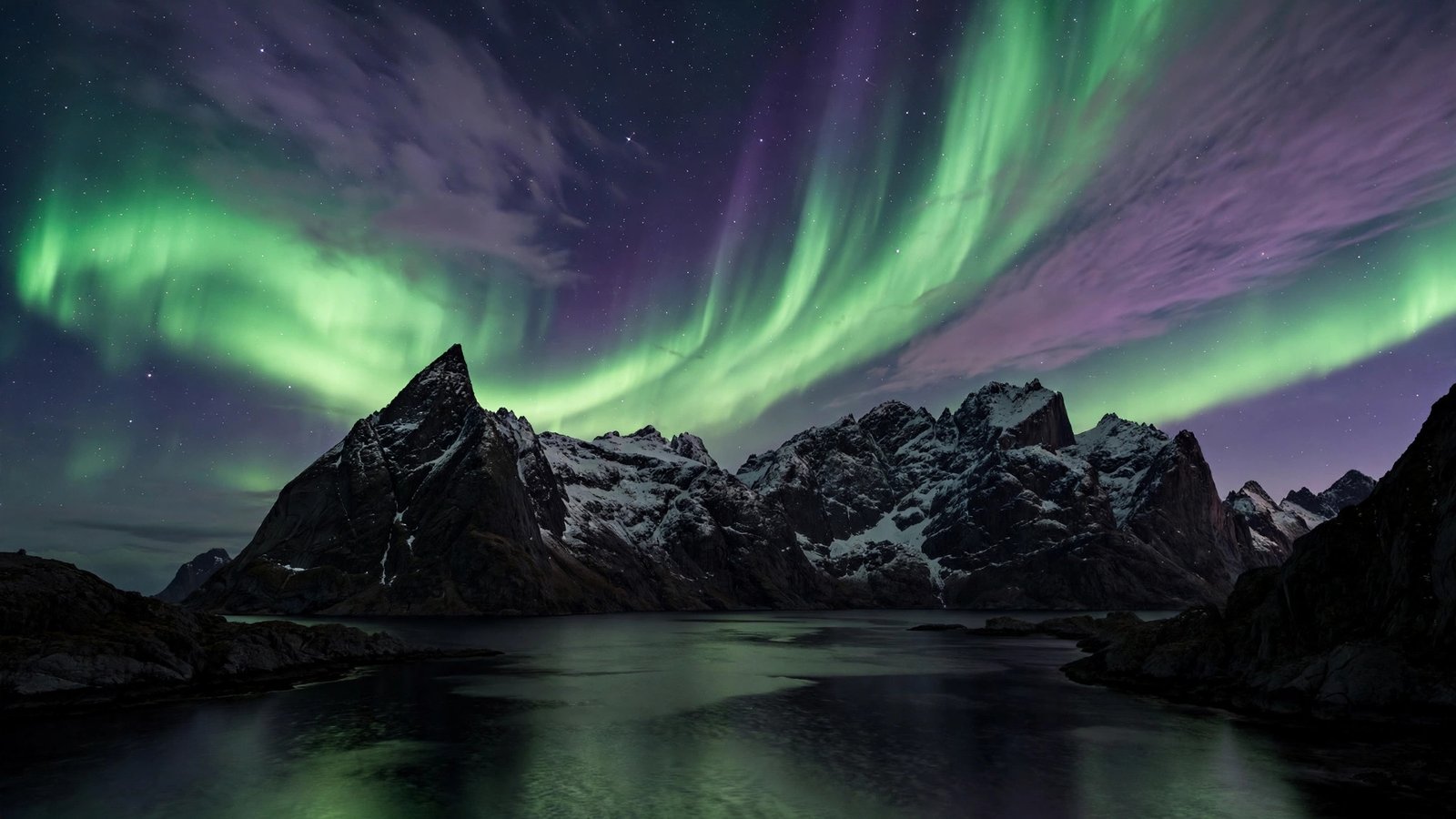
Lofoten’s honest complication is its maritime climate. The islands sit in the Atlantic storm track, and cloud cover is the single biggest variable in aurora success — bigger than solar activity in most weeks. Inland locations (Abisko, interior Finnmark, Finnish Lapland) enjoy statistically clearer skies; Lofoten counters with mobility (you can drive the E10 hunting for gaps between fjord arms and mountain weather) and with foregrounds worth the gamble. Experienced guides reckon that across a stay of four to five nights in season, most visitors see the lights at least once — and across one or two nights, plenty do not. Plan accordingly: aurora is a multi-night project.
Three forecasting habits separate the successful from the frozen:
- Aurora forecasts: the Norwegian Meteorological Institute’s aurora forecast and services like Yr’s aurora maps estimate the Kp index and oval position. At Lofoten’s latitude, even a modest Kp 2–3 puts the aurora overhead when skies are clear — you do not need a geomagnetic storm, you need a hole in the clouds.
- Cloud forecasts by the hour, checked fjord by fjord; a clear patch 40 minutes west is a normal Lofoten evening’s drive.
- Moon awareness: a full moon washes out faint aurora but lights the landscape beautifully for photography; a new moon gives the darkest sky and the most visible stars and Milky Way behind strong displays. Neither is “bad” — they are different photographs.
And one expectation to set with your own eyes: a weak aurora looks pale and grey-green to the naked eye (human night vision is poor at color); a strong one is unmistakably green, moving, and occasionally joined by purple and red fringes. Cameras see more color than eyes do — the photographs that inspired your trip were all taken by cameras.
Where to Watch (and the Guided Option)
The rules are simple: dark, north-facing where possible, away from village lights, with a foreground that makes the photograph — a fjord for reflections, a rorbu row, a peak. Beaches on the north and west coasts (Uttakleiv, Haukland, Eggum, Skagsanden near Ramberg) are the classic public choices, and the detailed spot-by-spot mapping lives in our companion aurora-spots guide linked above.
Guided aurora tours earn their money on three things: the forecast work (they drive to the clear sky, sometimes an hour or more), the photography help, and the driving itself on dark winter roads. On a short trip — two or three nights — a tour on your first night is a rational purchase: you learn the craft and the lay of the land, and can self-drive the following nights with what you learned. Dress for stationary Arctic cold regardless: aurora watching is mostly standing still, and the correct outfit is ski-level insulation plus chemical hand warmers in reserve.
How to Photograph the Northern Lights in Lofoten
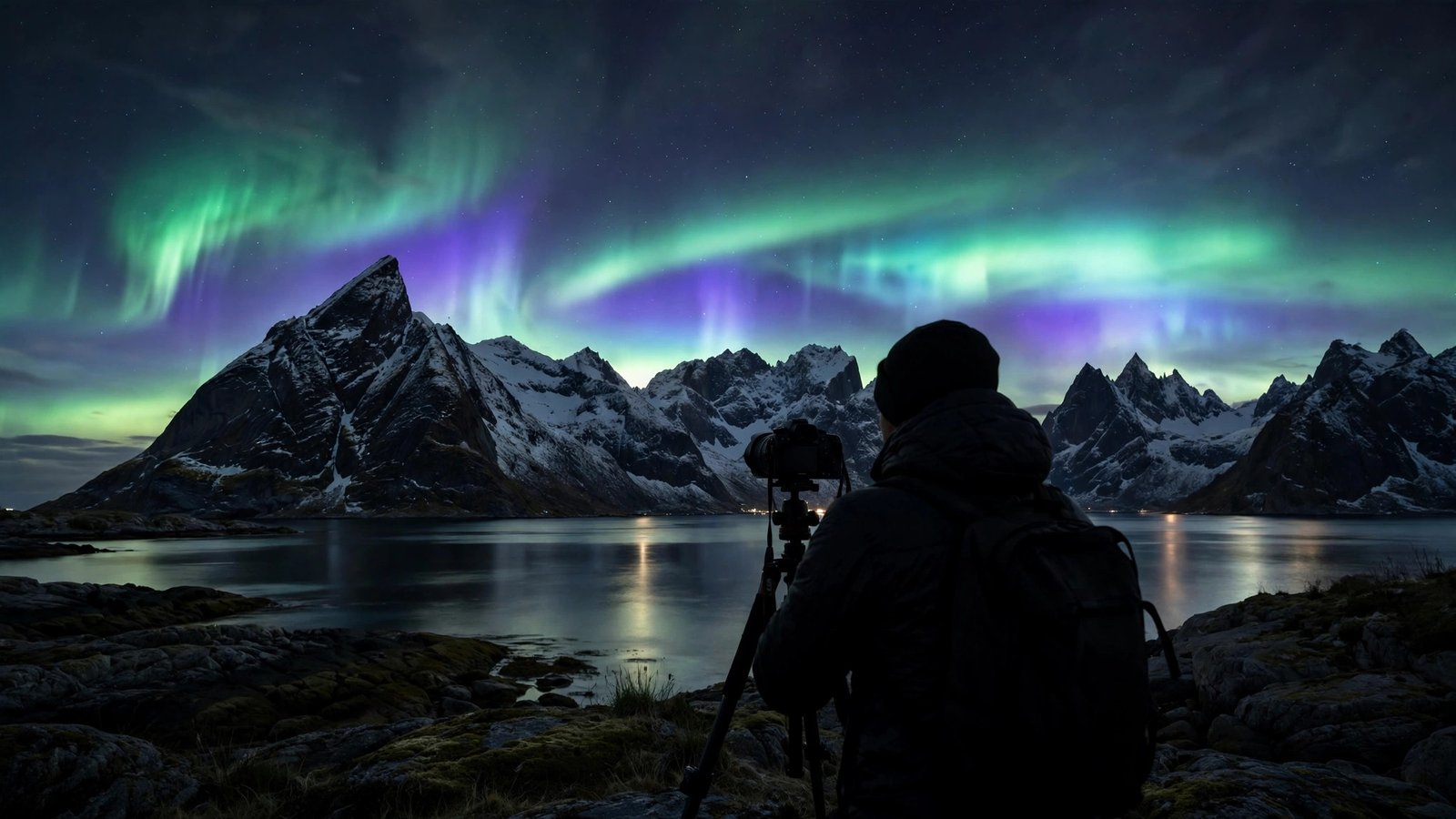
The aurora is easier to photograph than its reputation suggests, because the modern camera does most of the work. The non-negotiables:
- A tripod. Exposures run from 2 to 15 seconds; handheld is not a plan. Weight it against the wind and turn image stabilization off on a tripod.
- Manual focus to infinity, set in daylight on a distant peak or with live-view on a bright star; tape the focus ring if your lens creeps. Autofocus hunts uselessly in the dark.
- The settings ladder: widest aperture (f/2.8 or wider if you have it), ISO 1600–3200, shutter 5–15 seconds for slow arcs, shorter (2–6 seconds) when the aurora dances fast, to keep structure instead of green mush. Shoot RAW; white balance around 3200–3800K keeps greens honest.
- Compose foreground first. The shot is the fjord, the cabin, the peak — the aurora is the sky’s contribution. Reflections in still water double the display; a headlamp briefly waved can paint foreground interest (sparingly, and never at other photographers).
- Phones work now. Recent flagship phones in night mode, braced on a tripod or a rock, produce genuinely good aurora images; the same rules — support, patience, dark location — apply.
- Cold discipline: batteries drain fast in the cold (spares in an inside pocket), lenses fog when brought straight into a warm cabin (leave the camera in its bag to warm slowly), and your own hands are the real limit — liner gloves under mittens you can flip back.
Above all: put the camera down for part of every display. The photograph is the souvenir; the standing-under-it is the experience you actually came for.
Midnight Sun in Lofoten
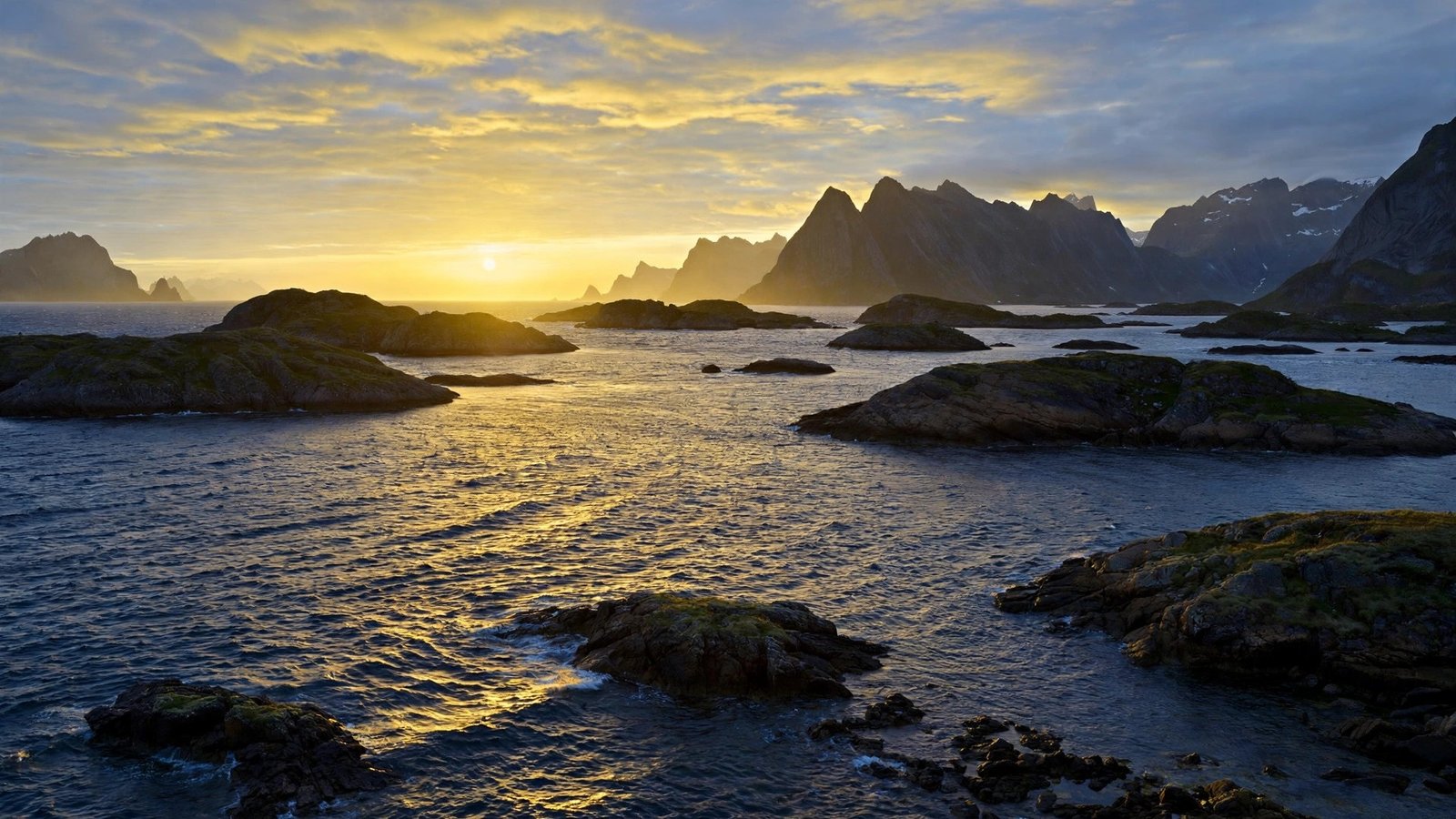
The northern lights have a mirror twin, and a complete guide should name it. From roughly May 28 to July 14, the sun in Lofoten never sets: it dips toward the northern horizon at “midnight,” turns the sea and peaks gold, and climbs again. The midnight sun is the aurora’s opposite in every way — guaranteed rather than hunted, warm-toned rather than green, and best watched from the west-facing beaches (Uttakleiv, Eggum, Unstad, Gimsøy) where the sun hangs over open ocean.
The pairing matters for trip planning: you cannot have both in one trip, and the choice between them is really the choice between Lofoten’s two great seasons, which our best time to visit Lofoten guide weighs month by month. Travelers who have done both tend to describe them as equal and opposite pilgrimages — and most end up making both.
Staying Safe and Considerate on Aurora Nights
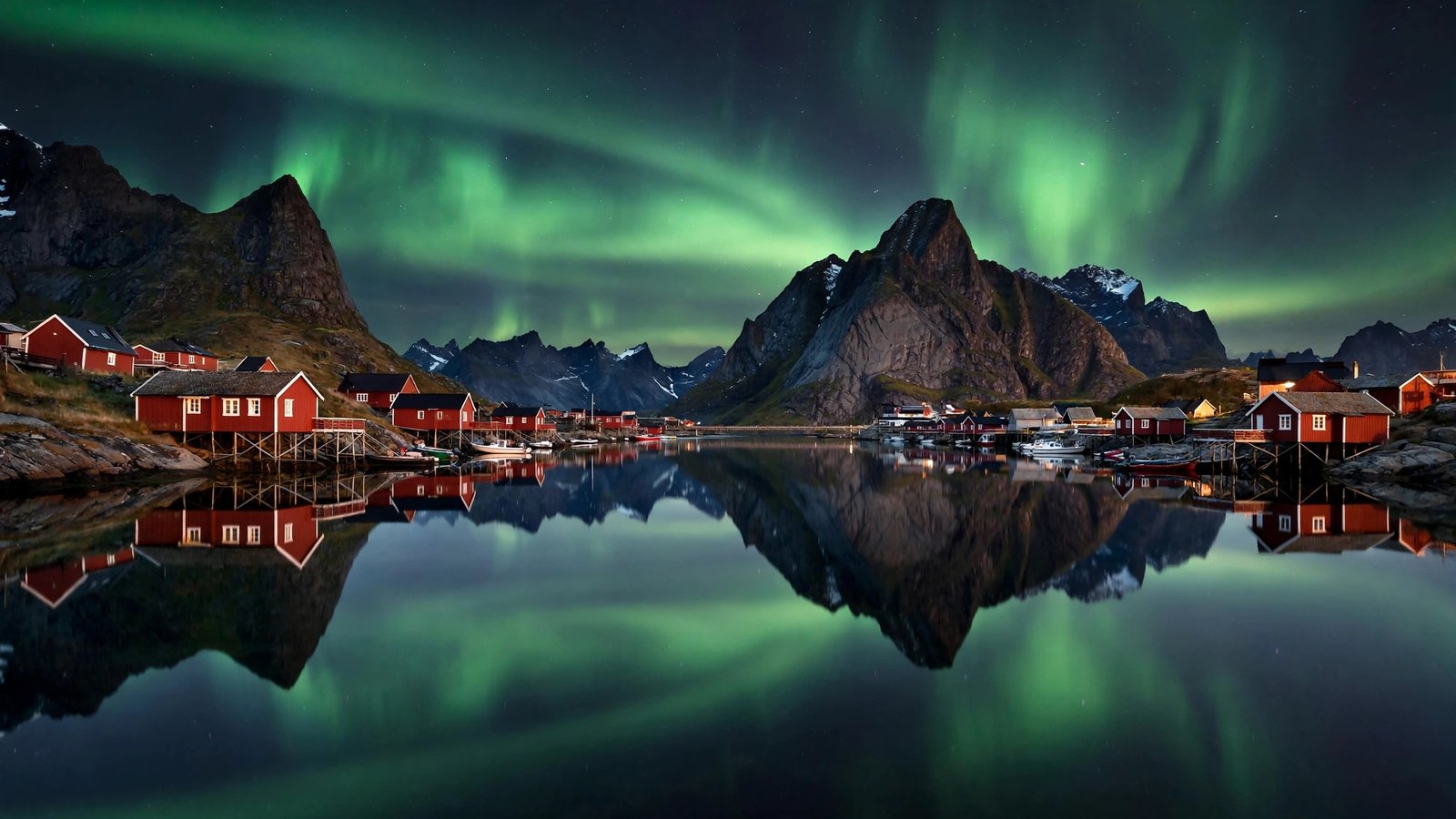
Aurora hunting happens on dark Arctic roads in winter conditions, and the safety rules are as practical as the photography rules. Park completely off the roadway — a car half on a narrow, icy E10 is a hazard to everyone, and Norwegian drivers do not expect stationary vehicles around blind bends. Wear a reflective vest or band if you are standing anywhere near the road; tour operators hand them out for a reason. Keep headlamps on red mode where your gear allows it, both for your own night vision and for the photographers around you.
Consideration runs the same direction. The famous beaches and viewpoints host many tripods on good nights: ask before setting up in someone’s frame line, never shine white light across a group without warning (“light!” is the traditional shout before you do), and take your litter and your footprints’ damage home — the beaches are also farms, bird habitat and people’s front yards. If a display erupts while you are parked beside a house in a village, remember the residents are watching it too, usually with pleasure and occasionally with opinions about headlights in their windows.
Finally, the cold is a safety issue, not a comfort detail: aurora watching means standing still for an hour or more in sub-freezing wind. Dress one full level warmer than you think, keep the car warm and reachable, and call the night when fingers stop working properly — the lights will return on another evening, and Lofoten rewards those who stay functional enough to see them.
Frequently Asked Questions
What is the best month for northern lights in Lofoten? February and March for the full winter scene with long nights; late September for the mild, road-friendly version with strong equinox activity. Both beat December for weather odds and daylight balance.
How many nights do I need? Four to five aurora-season nights is the honest recommendation for a good probability of at least one clear, memorable display under typical Lofoten weather patterns. One-night visits are lottery tickets, and everyone involved knows it.
Can I see the aurora from Svolvær town? On strong nights, yes — but light pollution costs you the faint displays, which are most of them. A 15-minute drive to a dark beach transforms the odds and the photographs.
Do I need a tour, or can I self-drive? Self-driving works if you are comfortable on dark, possibly icy roads and follow the cloud forecasts. Tours add forecast expertise, photography help and a driver — worth it on short trips.
The Bottom Line
The lofoten islands northern lights ask for the oldest travel bargain: patience in exchange for wonder. Come in the dark season, stay at least four nights, follow the cloud gaps like the locals do, set up the tripod on a beach with a fjord for a mirror — and when the sky finally opens over Reinefjord in ribbons of green, you will understand completely why people build entire trips, and then return trips on top of them, around a light that cannot be scheduled, only waited for.
