

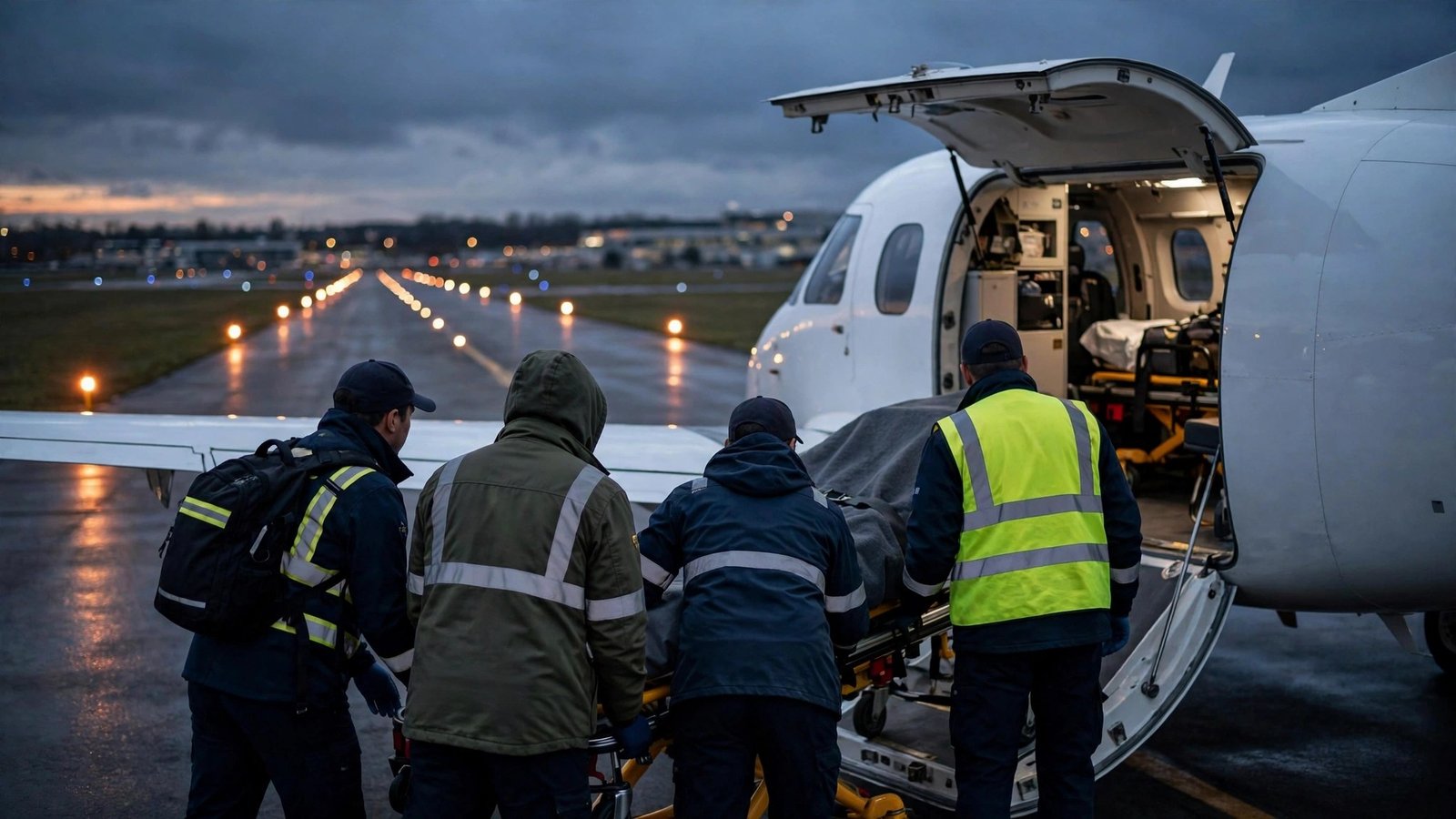
Emergency medical evacuation coverage is the benefit travelers most consistently under-buy, and the one whose absence can produce the largest bill in all of travel: an air ambulance. When you are seriously ill or injured somewhere that cannot treat you, this coverage pays to move you — by helicopter, fixed-wing air ambulance, or commercial flight with a medical escort — to a hospital that can.
This guide explains how evacuation coverage works, what evacuations realistically cost, how much coverage different trips demand, and how it connects to the related benefit of medical repatriation. It builds on the medical foundations in our travel medical insurance guide, and it applies to every kind of trip, from cruises to mountain treks.
What evacuation coverage actually pays for
Emergency medical evacuation coverage pays for medically necessary transport when local care is inadequate for your condition. The key phrase is “medically necessary,” and the decision is made by physicians — yours at the scene, the insurer’s medical team, and the assistance company coordinating the move — not by the traveler and not by preference.
A covered evacuation can take several forms:
- Ground or helicopter transfer to the nearest hospital able to treat you
- Fixed-wing air ambulance to a regional center of excellence, or back to your home country when that is medically appropriate
- Commercial flight with a medical escort, when you are stable enough to fly seated or on a stretcher with professional accompaniment
- Transport of a companion or family member in defined circumstances on some policies, and return of minor children left unattended by your hospitalization
The assistance company is the operational heart of the benefit. Its coordinators choose the aircraft, clear the receiving hospital, handle the paperwork between facilities, and guarantee payment. When you buy evacuation coverage, you are buying that machinery as much as the money — which is why the quality of the insurer’s assistance operation matters as much as the limit on the certificate. The U.S. State Department repeatedly stresses this benefit in its insurance guidance for travelers abroad, noting that evacuation without coverage can be financially devastating.

how much medical evacuation coverage do i need
The practical question — how much medical evacuation coverage do i need — starts with what evacuations cost. Reported costs vary enormously with distance and aircraft type: a short helicopter transfer may run into the tens of thousands of dollars, a regional air-ambulance flight commonly reaches well into five figures, and a long-haul air ambulance between continents can exceed $100,000 and climb far beyond it. Treat these as reported ranges, not quotes — but they explain why advisors treat evacuation limits differently from every other number in the policy.
Working benchmarks used widely by travel advisors look like this: at least $250,000 of evacuation coverage for ordinary international travel, $500,000 or more for cruises, remote regions, adventure trips, and destinations far from major hospitals, and $1,000,000 for genuinely remote expeditions or travelers whose conditions make evacuation more likely. Many strong policies bundle evacuation at these levels by default; weaker ones cap it at $50,000 or $100,000, which a single serious incident can consume entirely.
Distance is the multiplier. An evacuation from a Caribbean island to Florida is a different financial event from an evacuation from Central Asia, a Pacific island, or a ship mid-ocean. When in doubt, size the limit for the longest plausible flight home from the farthest point of your itinerary, and then choose the next tier up — the premium difference between tiers is usually small compared with the protection gained.
medical repatriation insurance
Medical repatriation insurance is the return-home half of evacuation coverage, and the term is used in two related ways. In its transport sense, repatriation means bringing you back to your home country for continued treatment once you are stable enough to travel, when the insurer’s physicians judge that appropriate — some policies give the insurer discretion here, others state clearer triggers, and the wording is worth reading if being treated at home matters to you or your family.
In its second sense, repatriation of remains covers the preparation and transport of a traveler’s body home in the event of death abroad — a grim but genuinely valuable benefit, since international mortuary transport is expensive, paperwork-heavy, and almost impossible for a grieving family to arrange alone at distance. Most comprehensive policies include a defined amount for this; check that yours does, and at what limit.
Repatriation benefits also intersect with international travel insurance generally: the same assistance team coordinates them, and the same requirement applies — call early, because unauthorized arrangements made privately may not be reimbursed in full.
When evacuation is not covered
Evacuation coverage has boundaries travelers should know. It does not pay to move you simply because you prefer a different hospital, want to be closer to family, or feel anxious about local care, when local treatment is judged adequate. It generally excludes evacuation arising from excluded activities — the skiing, diving, and altitude scenarios covered by adventure add-ons — and from pre-existing conditions where the exclusion applies and no waiver was secured.
It also requires coordination. If you charter your own aircraft without contacting the assistance line, the insurer may reimburse only what its arranged transport would have cost, or decline on the grounds that medical necessity was never established through its process. In a genuine emergency, call the assistance number first if it is humanly possible, or have a companion call while you are treated. That single phone call activates the entire machinery you paid for.
Security and political evacuation is a separate benefit on some policies, covering extraction from a destination that becomes dangerous for non-medical reasons. Do not assume it rides along with medical evacuation; look for it by name if your itinerary warrants it.
Evacuation on cruises and in remote places
Two settings stress evacuation coverage hardest. On a cruise, the ship’s medical center can stabilize but rarely definitively treat a major event, so evacuation — by helicopter to shore, or at the next port — is a standard part of serious care, and its cost reflects marine logistics. Our guide to the best travel insurance for cruises treats this in cruise-specific detail.
In remote regions — mountains, deserts, jungles, small islands — the evacuation chain is longer and more improvised: a ground transfer to airstrip, a charter to a capital, then an international air ambulance. Each leg adds cost and each handoff adds the need for a competent coordinator. Travelers heading to such places should carry evacuation limits at the top of the normal range and confirm the assistance network actually operates in their region.

How to buy evacuation coverage well
Evacuation coverage is rarely sold alone; it rides inside travel medical and comprehensive policies, plus standalone membership-style products from evacuation specialists for very frequent or remote travelers. When comparing policies, extract the evacuation limit and read three clauses: who decides medical necessity, whether repatriation home for treatment is included or only transport to the nearest adequate facility, and whether a companion’s travel is covered in any circumstance.
Then apply the sizing rule from earlier: farthest point, longest plausible flight, one tier up. Evacuation is the cheapest catastrophic protection in the entire policy relative to the bill it prevents, and it is the last limit a traveler should ever trim to save premium.
What an evacuation actually looks like, step by step
Travelers who have never used the benefit often imagine a single dramatic flight. In reality an evacuation is a chain of decisions. It begins with the call to the assistance line, from you, a companion, or the treating facility. The assistance company’s medical team confers with the local physicians, reviews records, and decides whether local care is adequate or a move is medically necessary.
If a move is approved, coordinators select the transport method matched to your condition — a ground ambulance for a short transfer, a helicopter when speed or terrain demands it, an air ambulance with a medical crew for longer distances. They confirm a receiving hospital and physician, arrange the handoffs, and guarantee payment to each provider so you are never negotiating from a stretcher.
On arrival, your care transfers to the receiving team, and the insurer’s file follows the treatment. If repatriation home is part of the plan, a second movement is arranged when you are stable enough for it. The traveler’s role in this entire machinery is deliberately small: make the first call early, keep the assistance number reachable, and let the coordinators coordinate. Practically everything that can go wrong with an evacuation claim traces back to that first call being late or never made.

Frequently asked questions
Will the insurer fly me home, or only to the nearest hospital? The standard promise is transport to the nearest facility that can treat you adequately. Repatriation home for continued care is included on many policies once you are stable, subject to the certificate’s wording — check whether it says “nearest adequate” only, or also covers return home when medically appropriate.
Does evacuation coverage pay for a family member to join me? Some policies include a bedside-visit benefit when you are hospitalized abroad for a defined number of days, covering a relative’s economy transport. It is a named benefit, not an assumption — look for it in the certificate.
What if I refuse an evacuation the insurer arranges? Declining arranged transport can complicate or end the insurer’s obligation for resulting costs. If you disagree with the medical decision, ask for the reasoning in writing and involve your treating physician, rather than simply refusing and arranging your own way home.
Is evacuation included in every travel policy? Nearly every travel medical and comprehensive policy includes it, but the limit varies from token amounts to $1,000,000 or more. The benefit’s presence is not the question — its size and its decision rules are. Always read the evacuation limit as a standalone number when comparing policies, and never let a strong medical limit distract you from a weak evacuation one, because the two protect against very different bills.
Conclusion
Nobody books a trip imagining an air ambulance, but the travelers who come home with their savings intact are the ones who insured the possibility anyway.
Emergency medical evacuation coverage is the benefit that turns the worst day of a trip into a logistics problem instead of a financial catastrophe. Size it for distance, buy it inside a policy with a real assistance operation, and remember the phone call that activates it. Of every number printed on your policy certificate, this is the one to get generously, deliberately right — because it is the one you will never be able to renegotiate from a hospital bed.
