
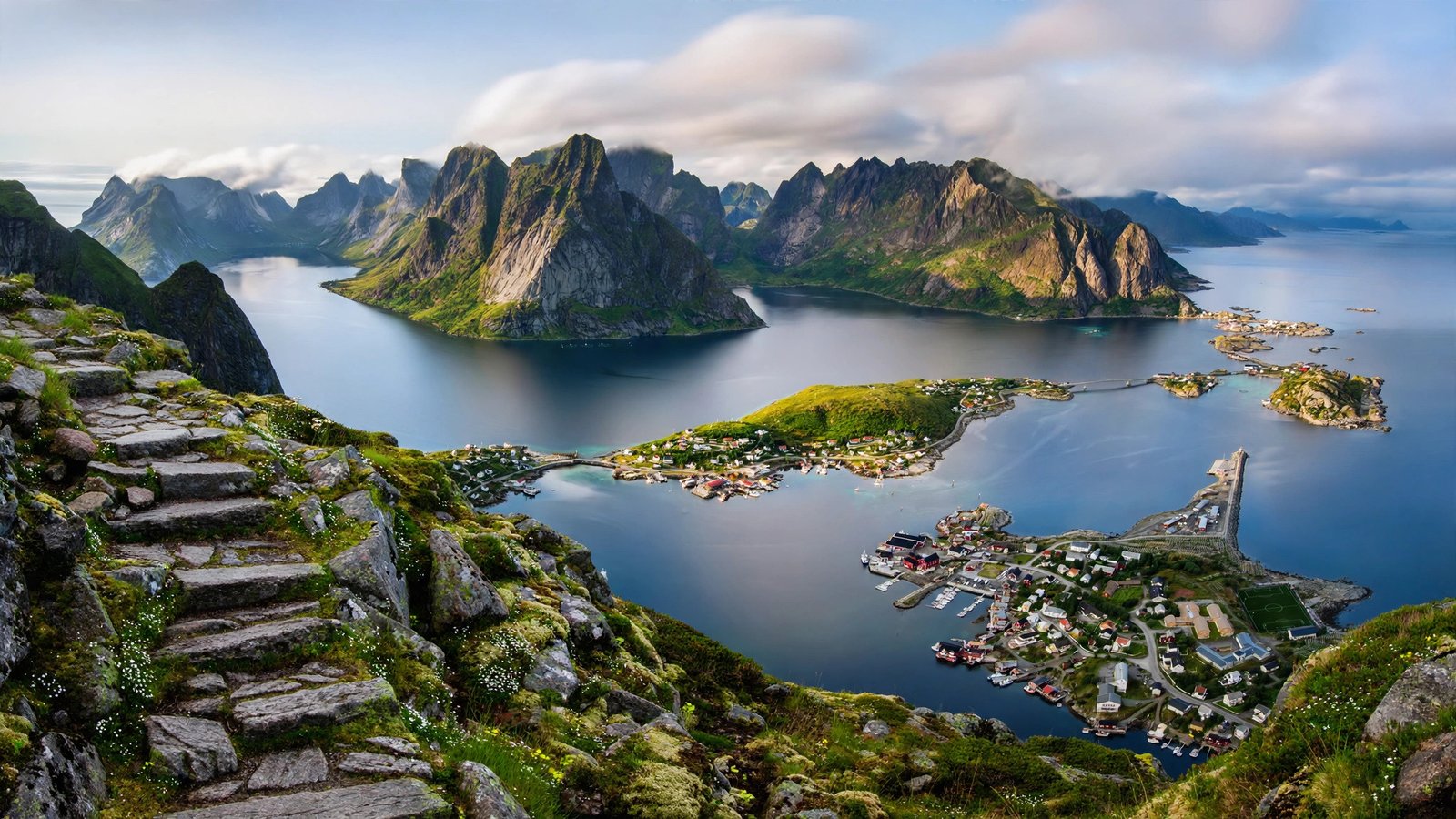
Lofoten islands hiking operates on a glorious imbalance: the mountains are not high — the biggest summits barely pass 1,100 meters — but they rise straight out of the sea, so a two-hour walk buys the kind of alpine-above-the-fjord panorama that takes a full expedition day in most ranges. Add Arctic light, trails that start in fishing villages, and summits you can descend in time for a harbor dinner, and you have one of Europe’s great day-hiking destinations.
This guide ranks the essential day hikes, led by the famous Reinebringen staircase, and covers the seasons and safety culture that hiking at 68°N demands. It slots into the five-day framework of our Lofoten itinerary 5 days — most trips fit two or three of these hikes, and choosing them well is the point of this page.
Lofoten Islands Hiking at a Glance
For trip planning, here is the essential shape of it. The hiking season runs June to September, with the trails snow-free progressively through June and the midnight sun making evening ascents a Lofoten specialty. Most classic day hikes take 2–5 hours, start within a short drive of the E10, and top out between 300 and 700 meters — low altitudes, serious views. Difficulty concentrates in steepness and exposure rather than distance: Lofoten trails go up like ladders, often on rock, roots and bog, and the descents tax knees more than the climbs tax lungs.
You need no permits and pay no trail fees; the system runs on allemannsretten access and DNT maintenance. What you do need is the Arctic kit and the Arctic attitude covered later in this guide, because the islands’ small mountains produce full-size mountain weather. Plan honestly for that, and the hiking here is as safe as it is spectacular, in every month of its season.
Reinebringen Hike Guide
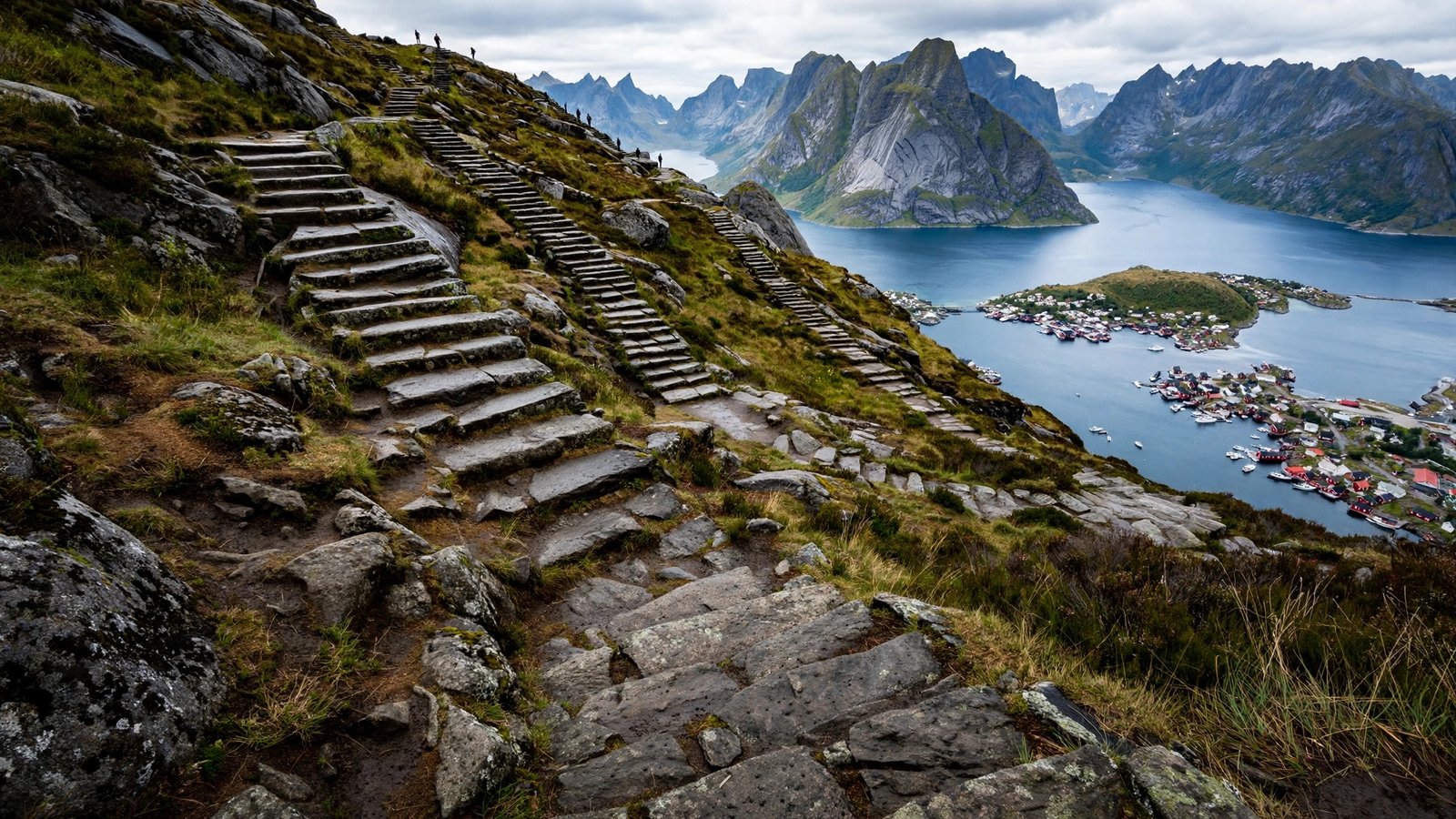
Reinebringen is Lofoten’s signature hike: a stone staircase of 1,978 steps, built by Nepalese Sherpas to end the erosion that was destroying the old trail, climbing some 448 meters from the edge of Reine to a saddle viewpoint above the village. The view from the top — Reinefjord’s arms below, the village and Hamnøy laid out like models, the Lofoten Wall running to the horizon — is the single most reproduced panorama in the islands, and it earns the status.
The practicalities, honestly stated:
- Effort and time: the staircase makes the route accessible to any reasonably fit walker, but 1,978 steps is a real workout — allow 2–3 hours round trip including summit time, more with photography. Poles help knees on the descent.
- Start point and parking: the trailhead sits by the E10 at the western edge of Reine; parking is the constraint. Options include the areas by the harbor and the Djupfjord side — arrive early in season, or better, walk from a Reine base and skip the parking question entirely.
- The old trail is closed for a reason. Erosion and rockfall closed the original route; the staircase is the way, and shortcutting off it damages exactly what the Sherpa project rebuilt.
- Never in winter. Reinebringen is a summer-and-shoulder hike: in snow and ice the route is exposed to avalanche risk and the steps become a slide. Local advice in winter is a closed door — respect it.
- Crowds: by midday in July the summit terrace is social. Dawn and evening ascents — trivially easy under the midnight sun — are the connoisseur’s hours.
Weather judgment governs everything: the view is the entire product, so save Reinebringen for your clearest window in Reine, not your scheduled day. That flexibility is built into our recommended itineraries for a reason.
Best Day Hikes in Lofoten
Beyond the famous staircase, the islands offer a full card of half- and full-day classics. The essentials, roughly east to west:
- Fløya and Djevelporten (Svolvær) — the capital’s home mountain: a steep, satisfying climb past the Djevelporten (“Devil’s Gate”) boulder wedged between cliffs, to a summit looking down on Svolvær and across to the mainland. Half a day; the fit can continue along the ridge toward Tuva.
- Tjeldbergtind (Svolvær–Kabelvåg) — the gentle introduction: a modest summit between the two towns with an outsized fjord panorama; the locals’ evening walk and the right first hike of a trip.
- Svolværgeita (Svolvær) — the town’s iconic twin-pinnacle is a climb, not a hike: guided ascents only, famous for the leap between the two horns. Watch it from below with a clear conscience if ropes are not your sport.
- Festvågtind (Henningsvær) — the steep cone above the islands’ prettiest village: 90 minutes of honest climbing to a summit that takes in Henningsvær, the Vestfjord and the Wall. A top-three Lofoten view for a half-day price.
- Glomtinden (Gimsøy/Rystad) — an easy ridge walk between the two coasts with views both ways — the low-effort, high-yield option near the Lofotr Viking Museum.
- Offerøykammen (Leknes) — the locals’ favorite summit above Leknes: a steady climb to a long ridge with the west-coast beaches spread below; superb in evening light.
- Mannen (Haukland) — the short, steep climb above Haukland beach to a summit between two of the famous beaches; combine with Uttakleiv for the classic beach-and-peak day.
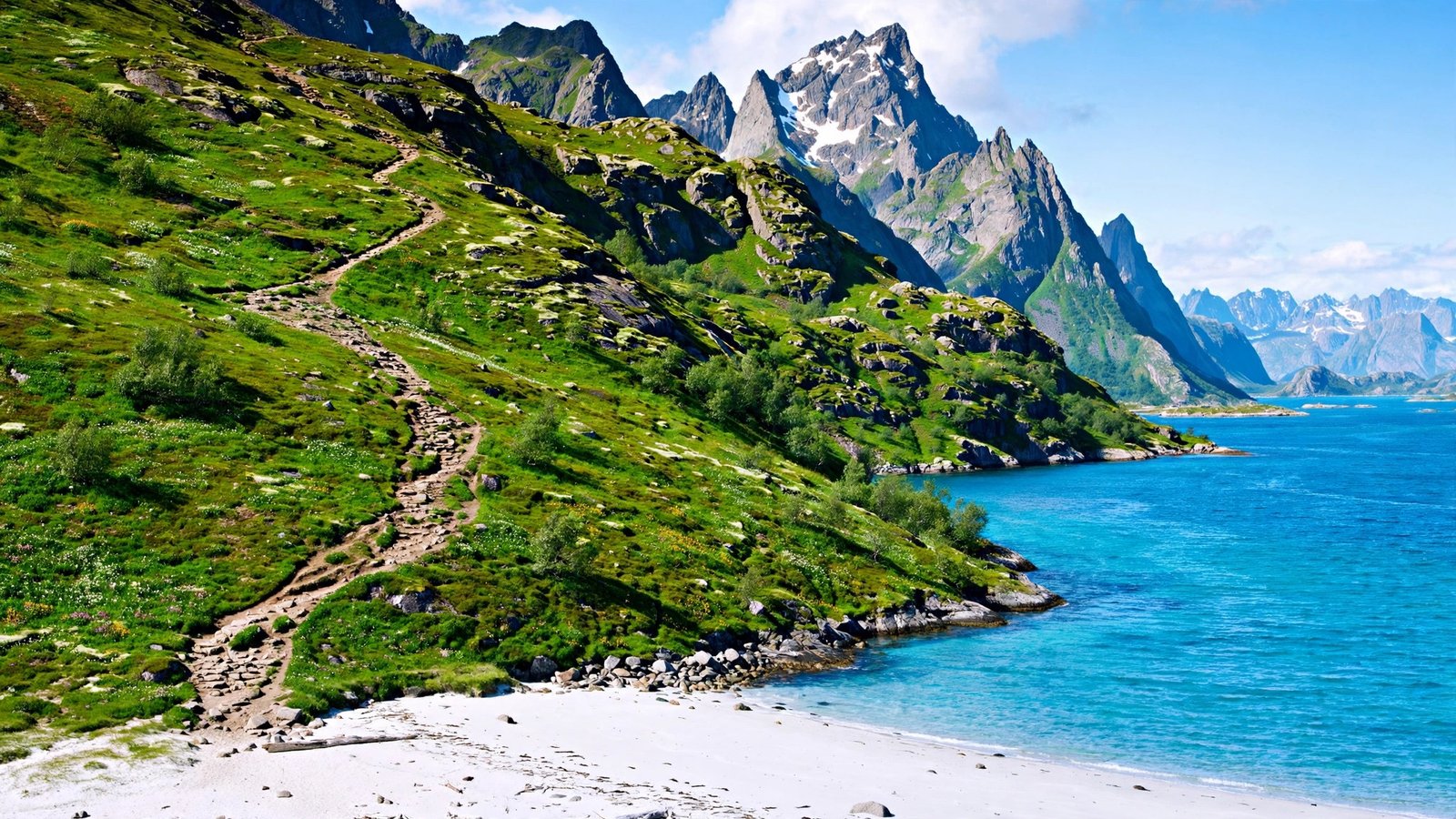
- Ryten and Kvalvika (Fredvang) — Lofoten’s other superstar: a grassy summit (543 m) above the isolated, golden Kvalvika beach, reached only on foot. Allow most of a day with beach time; the miniature “Fredvang” viewpoint en route is the postcard angle. Wild camping at Kvalvika under the midnight sun is a rite of passage — under allemannsretten rules and leave-no-trace discipline.
- Reinebringen — see above; the west end’s crown.
- Håen (Værøy) — for those taking the ferry to the bird island of Værøy: the ridge walk above the village with puffin-colony views in season and the Moskstraumen in the distance.
Ranking them is a fool’s errand — Festvågtind for a half day, Ryten for a full one, Reinebringen for the icon — but note the pattern: nearly all are 2–5 hour efforts with trailheads on or near the E10, which is why hiking integrates with a village-hopping trip so naturally, as our Lofoten villages guide describes them.
Seasons, Safety and the Norwegian Way
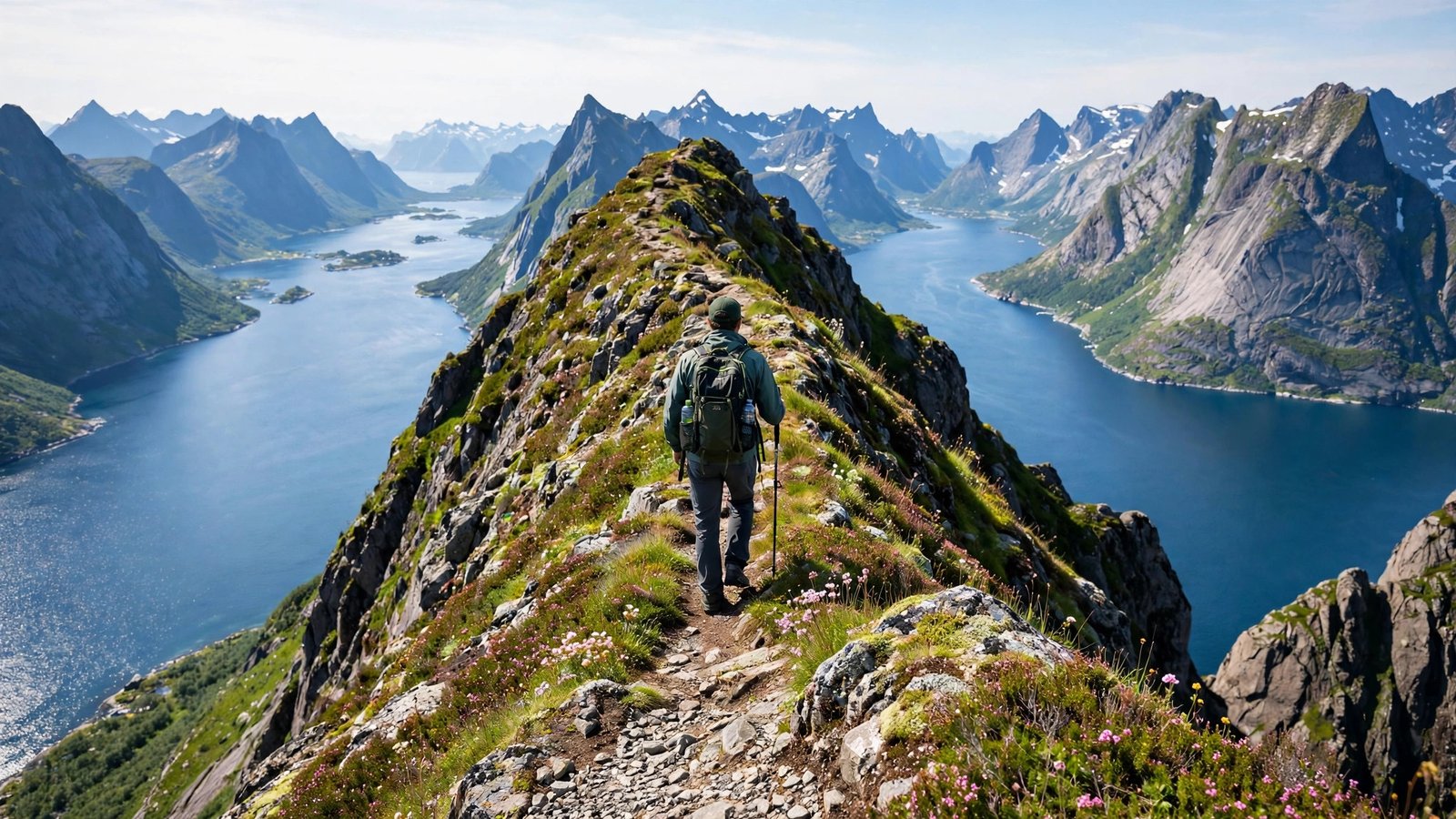
Season. The main hiking season runs June to September; May and October are possible for lower routes in settled conditions; winter hiking is a different sport (snowshoes, ski touring, avalanche education) and belongs with guides for all but the experienced. Trail details, route maps and cabin networks are maintained by the Norwegian Trekking Association — its trip planner UT.no is the official companion for route research before you arrive.
The safety culture is the one serious paragraph in this guide, and it deserves it. Lofoten’s weather changes faster than its forecasts update; carry the waterproofs, the warm layer, food, water and a charged phone on every hike, however short the summit looks from the harbor. Trails are marked with the red T cairns and paint of the DNT system, but Arctic paths cross bog, scree and exposed rock — proper footwear, not trainers, is the local expectation. Tell someone your route (or log it), respect closures and winter warnings absolutely, and remember that rescue in Norway is volunteer-run: the mountains are generous to the prepared and expensive, in every sense, to the careless.
Etiquette is the other half of the system: allemannsretten, the right to roam, lets you walk and camp widely in open country — in return, you camp away from houses, stay no more than a couple of nights in one spot, and leave the trail, the beach and the summit exactly as the next walker hopes to find them.
What to Wear and Carry
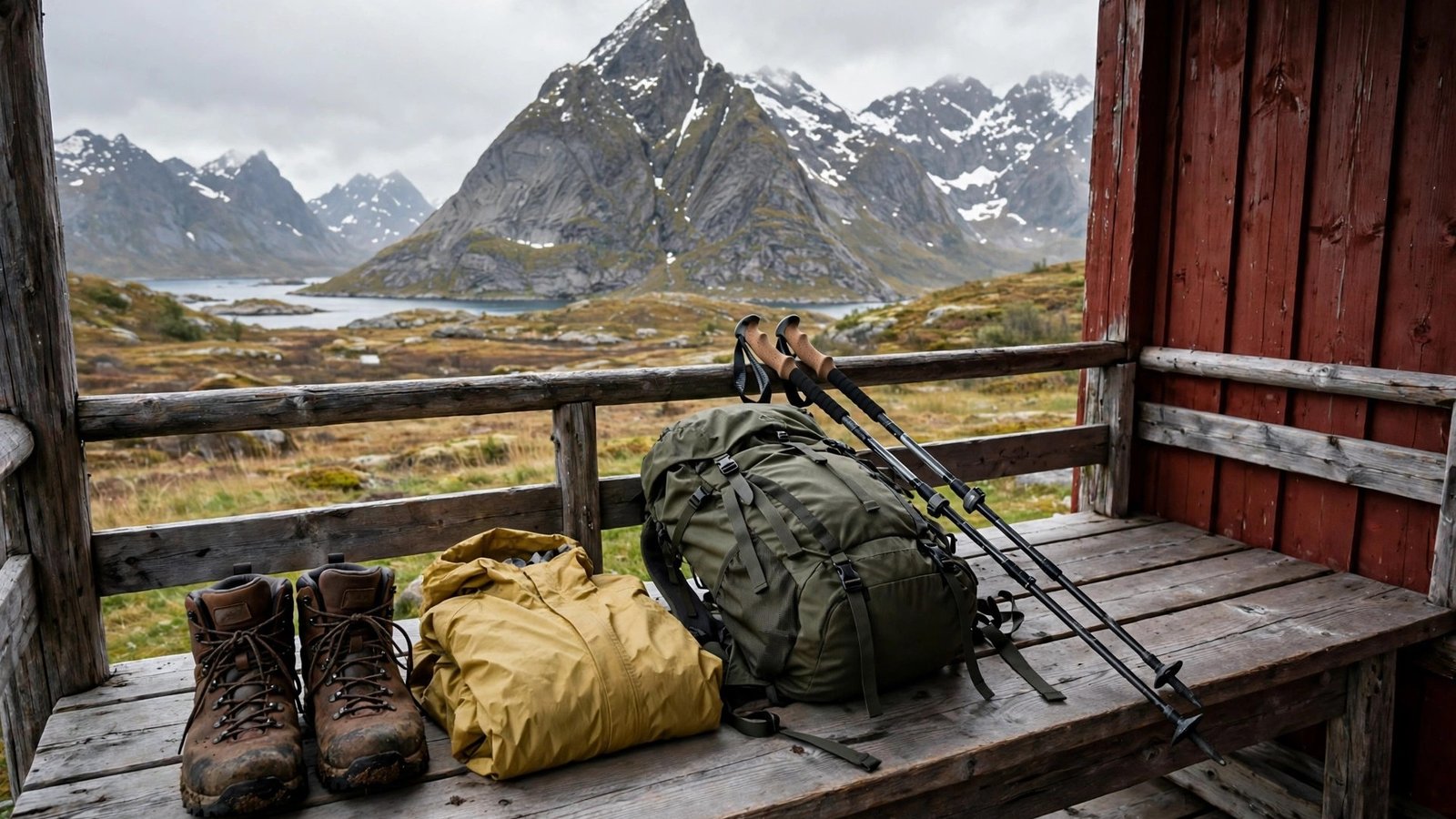
Lofoten hiking kit is unglamorous, standard and non-negotiable, and it fits in a 20-liter daypack:
- Waterproof hiking boots with ankle support, broken in — the trails are rock, bog and roots, and wet feet in Arctic wind end days.
- A real waterproof shell, jacket and pants, carried always; the islands’ rain arrives horizontally and without long warning.
- Warm layers including a hat and gloves, even in July — summits and ridges run cold, and the wind is the islands’ second language.
- Food and more water than you expect (streams on the routes are generally clean and locals drink from them, but carry the first liter regardless).
- Phone with the route downloaded (coverage is good on most classic trails but not guaranteed), a headlamp outside the bright months, and — in winter or on the high routes — the full avalanche kit and the training to use it, or a guide instead.
- Trekking poles if your knees vote for them — on 1,978 stone steps and Lofoten’s steep descents, they earn their carry.
Shops in Svolvær and Leknes stock everything on the list at Norwegian prices; the prepared arrive with it in the bag.
Frequently Asked Questions
What is the single best hike in Lofoten? Reinebringen for the famous view with a staircase’s effort; Ryten for the complete experience of summit plus wild beach. Most five-day trips can do both.
Are the hikes suitable for children? Tjeldbergtind, Glomtinden and Offerøykammen suit school-age children used to walking; Reinebringen’s steps are fine for determined older children. Exposed ridges and winter conditions are adult territory.
Do I need a guide? For the day hikes in this guide in summer, a map, the UT.no route and honest weather judgment suffice. For glaciers there are none here — but for winter summits, ski touring and Svolværgeita’s climb, a guide is the way.
When should I avoid hiking? In high wind, in whiteout or icy conditions on the steep routes, and whenever local advice says so. The season logic in our best time to visit Lofoten guide is the planning version of the same rule.
I am a beginner — where do I start? With Tjeldbergtind or Glomtinden on a clear day: both are honest walks rather than scrambles, with summit views that will recalibrate what you thought “easy hike” scenery could be. Graduate to Festvågtind, then take Reinebringen’s steps at your own pace. Lofoten’s great gift to beginners is that the reward curve starts at the bottom of the ladder — you do not have to earn the archipelago’s beauty at expert altitude.
The Bottom Line
Lofoten islands hiking is the rare case where the famous hike deserves its fame — and where the second rank of hikes is nearly as good and a fraction as crowded. Climb Reinebringen at dawn, give Ryten its full day, take Festvågtind on the evening the light is right, and respect the Arctic’s weather and closures without negotiation. The islands’ trails ask for fitness and humility in equal measure, and they repay both at a rate few places on Earth can match.
