
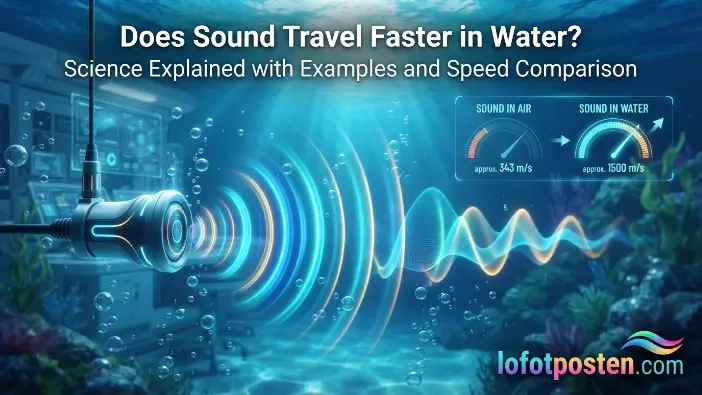
Welcome to Lofotposten. Have you ever wondered does sound travel faster in water than it does in air? The answer is yes. Sound travels much faster through water because water molecules are packed more closely together than air molecules. This allows sound waves to pass from one molecule to the next more efficiently, making underwater sound transmission significantly quicker.
Understanding how sound travels is important in everyday science, marine biology, engineering, and even military technology. From whales communicating across oceans to submarines using sonar systems, the speed of sound in water plays a vital role in many real-world applications. In this article, you’ll learn why sound travels faster in water, how different materials affect sound speed, and what factors influence underwater sound transmission.
The Short Answer: Does Sound Travel Faster in Water?
Sound is a form of energy produced when an object vibrates. These vibrations create sound waves that travel through a medium such as air, water, or solids. As the vibrations move from one particle to another, they carry sound until it reaches our ears, where the brain interprets it as speech, music, or other noises. Unlike light, sound cannot travel through space because it needs particles to transmit its vibrations. The speed of sound depends on the medium it travels through. It moves slower in air, faster in water, and fastest in most solids because their particles are more closely packed, allowing vibrations to pass more efficiently.
What Is Sound and How Does It Travel?
Sound is a form of energy that is produced when an object vibrates. These vibrations create sound waves that travel through a medium such as air, water, or solids. As the waves move from one particle to another, they carry sound until it reaches our ears, where the brain interprets it as speech, music, or other sounds. Unlike light, sound cannot travel through space because it needs particles to transfer its vibrations. The speed of sound depends on the medium it travels through. It moves slower in air, faster in water, and fastest in most solids because their particles are packed more closely together, allowing sound waves to travel more efficiently.
Understanding Sound Waves
Sound waves are created whenever an object vibrates. These vibrations cause the particles in a material such as air, water, or a solid to move back and forth, passing energy from one particle to the next. This chain reaction allows sound to travel from its source to our ears.
Unlike light, sound cannot travel through a vacuum because there are no particles to carry the vibrations. That’s why sound needs a medium, such as air, water, or a solid object, to move. Once the sound waves reach our ears, the brain processes them, allowing us to hear voices, music, and other sounds.
For example:
- A person speaking causes vocal cords to vibrate.
- A guitar string creates vibrations when plucked.
- Thunder produces vibrations after lightning rapidly heats the surrounding air.
In every case, sound moves because particles transfer energy from one to another.
Why Sound Needs a Medium
A medium is any substance that allows sound waves to travel, such as air, water, or solids. Sound moves by making the particles in the medium vibrate and pass energy from one particle to the next. Without these particles, sound cannot travel.
This is why sound cannot move through the vacuum of space, where there are almost no particles. The type of medium also affects how fast sound travels; generally, it moves slowest in gases, faster in liquids, and fastest in solids because their particles are packed more closely together.
Common sound-transmitting mediums include:
- Air: A gas through which sound travels commonly.
- Water: A liquid that carries sound faster than air.
- Glass: A solid that transmits sound quickly.
- Wood: A solid medium that allows sound to travel.
- Metal: A solid where sound travels very fast.
- Plastic: A solid that can carry sound waves.
Space is almost a perfect vacuum, meaning it contains very few particles. Because of this, sound cannot travel through space. This is why astronauts rely on radios rather than shouting to communicate outside their spacecraft.
Read Also: What is the safest way to travel
Why Does Sound Travel Faster in Water Than Air?
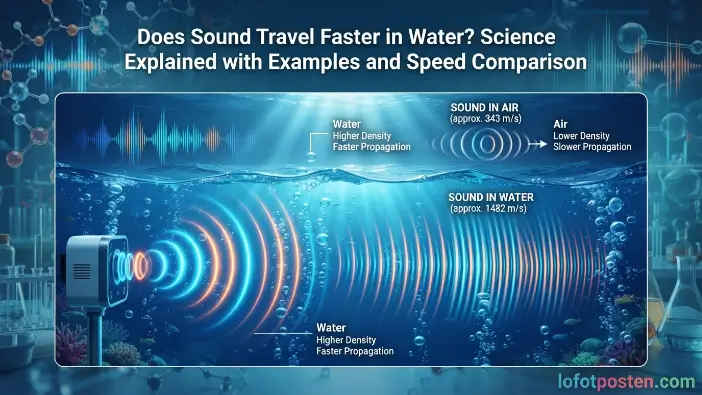
Sound travels faster in water than in air because the molecules in water are much more closely packed. When an object creates sound, it produces vibrations that move from one molecule to the next. Since water molecules are closer together, these vibrations are transferred more quickly, allowing sound waves to travel much faster than they do in air, where the molecules are spread farther apart.Another important reason is that water is less compressible and more elastic than air. This means water can transmit sound energy more efficiently with less energy loss. Even though water is denser than air, its higher elasticity helps sound move faster. On average, sound travels at about 1,480 meters per second in freshwater, compared to only 343 meters per second in air.
Molecules Are Closer Together
One of the main reasons sound travels faster in water is that water molecules are much closer together than air molecules. In air, the molecules are spread far apart, so sound vibrations must travel a greater distance before reaching the next particle. This slows down the movement of sound waves.
In water, the molecules are tightly packed, allowing vibrations to pass quickly from one molecule to another with very little delay. A simple way to imagine this is a line of people standing shoulder to shoulder. If the first person gives a gentle push, the movement quickly reaches everyone in the line. However, if the people are standing far apart, it takes much longer to pass the movement along. In the same way, the closely packed molecules in water help sound travel much faster than in air.
The Role of Elasticity
Elasticity is another key reason why sound travels faster in water than in air. Elasticity is a material’s ability to return to its original shape after being compressed. Materials with higher elasticity transfer sound vibrations more efficiently, allowing sound waves to move quickly through them.
Water is much less compressible and more elastic than air, so it loses very little energy as sound travels. This helps sound waves maintain their speed and travel over long distances underwater. Because of this property, marine animals like whales and dolphins can communicate across vast areas of the ocean, and technologies such as sonar work effectively for underwater navigation and exploration.
Density vs. Elasticity
Many people think that denser materials always slow down sound, but that is not true. The speed of sound depends on both density and elasticity. Although water is denser than air, it is also much more elastic, which allows sound vibrations to move quickly with very little energy loss.
This is why sound travels much faster in water than in air. The same principle applies to solids like steel, where particles are tightly packed and highly elastic. As a result, sound travels fastest through most solids, making elasticity just as important as density in determining the speed of sound.
Speed of Sound in Different Mediums
Sound does not travel at the same speed in every material. The speed of sound depends on how closely the particles are packed and how easily they transfer vibrations. In general, sound travels slowest in gases, faster in liquids, and fastest in solids because their particles are more closely packed and transmit sound waves more efficiently.For example, sound travels at about 343 meters per second in air, around 1,480 meters per second in freshwater, and nearly 5,960 meters per second in steel. This difference explains why underwater sounds travel long distances and why vibrations move very quickly through solid materials like metal.
Sound in Air
Air is the most common medium through which we hear sound in everyday life. When someone speaks, plays music, or makes any noise, sound waves travel through the air until they reach our ears. At a temperature of 20°C (68°F), sound travels through dry air at about 343 meters per second.
However, sound moves relatively slowly in air because the air molecules are spread far apart. The vibrations must travel from one molecule to another, which takes more time than in liquids or solids. Factors such as temperature and humidity can also affect the speed of sound, with warmer air allowing sound to travel slightly faster.
Several factors can affect this speed, including:
- Temperature
- Humidity
- Air pressure (to a smaller extent)
On a warm day, sound generally travels slightly faster because warmer air molecules move more quickly and transfer vibrations more efficiently.
Sound in Water
Water is a much better medium for transmitting sound than air. In freshwater, sound travels at an average speed of about 1,480 meters per second, while in seawater it travels even faster at around 1,530 meters per second. This is because water molecules are packed closely together, allowing sound vibrations to move quickly from one molecule to the next.
The high speed of sound in water allows it to travel over very long distances with little energy loss. Marine animals such as whales and dolphins rely on this to communicate, navigate, and locate food. Scientists and researchers also use underwater sound waves in sonar technology, ocean floor mapping, submarine navigation, and marine life tracking, making sound an essential tool for exploring and understanding the underwater world.
Sound in Solids
Sound travels fastest through solids because their particles are packed very closely together and are strongly bonded. This allows vibrations to pass from one particle to the next almost instantly, making sound travel much faster than it does in liquids or gases.
For example, sound travels through steel at nearly 6,000 meters per second, which is much faster than its speed in water or air. This is why you can often hear a train approaching through the railway tracks before hearing it through the air. The same principle applies to metal pipes and other solid objects, which efficiently transmit sound over long distances.
Factors That Affect the Speed of Sound in Water
Although sound travels much faster in water than in air, its speed is not constant. Several environmental factors, including temperature, salinity, and water pressure, can affect how quickly sound waves move underwater. These factors change the physical properties of water, which influences the transmission of sound.Understanding these factors is important in fields such as marine biology, oceanography, underwater communication, and sonar technology. By studying how sound behaves under different conditions, scientists and engineers can improve submarine navigation, map the ocean floor, track marine animals, and conduct more accurate underwater research.
Temperature
Temperature is one of the most important factors affecting the speed of sound in water. As the water gets warmer, its molecules gain more energy and move faster. This allows sound vibrations to pass more quickly from one molecule to another, increasing the speed of sound.
In contrast, colder water slows down molecular movement, causing sound to travel more slowly. For example, sound moves faster in the warm waters of tropical oceans than in the cold waters near the poles. Even small changes in water temperature can affect underwater communication, sonar systems, and scientific measurements, which is why temperature is carefully monitored during ocean research.
Salinity
Salinity means the amount of dissolved salt present in water. Seawater has a higher salinity than freshwater because it contains more dissolved minerals and salts. The presence of salt makes seawater slightly denser and changes its ability to transfer sound vibrations.
Because seawater is denser and slightly more elastic than freshwater, sound waves can travel a little faster through it. This is why sound moves at about 1,530 meters per second in seawater compared to around 1,480 meters per second in freshwater.
Pressure and Depth
Pressure and depth also affect how fast sound travels in water. As you move deeper into the ocean, the weight of the water above creates greater pressure. This pressure slightly compresses the water molecules and makes them even closer together, allowing sound vibrations to transfer more efficiently.
Because of this, sound generally travels faster in deeper parts of the ocean compared to areas near the surface. This difference is important for scientists and engineers because they need to understand how sound moves underwater when designing sonar systems, submarine technology, and ocean research equipment. By studying pressure and depth, oceanographers can predict sound movement and improve underwater communication and exploration.
Real-World Examples of Sound Traveling in Water
The ability of sound to travel quickly and efficiently underwater has many important uses in the real world. Since light cannot travel far through deep water, sound becomes one of the most effective ways to communicate, navigate, and study the underwater environment.From marine animals communicating across oceans to advanced technologies like sonar, underwater sound helps scientists, researchers, and engineers explore and understand the world beneath the ocean surface.For example, whales and dolphins use sound waves to communicate, find food, and navigate through dark ocean environments. Humans also use underwater sound for submarine navigation, mapping the ocean floor, detecting underwater objects, and studying marine life.
Sonar Technology
SONAR (Sound Navigation and Ranging) is a technology that uses sound waves to detect and locate objects underwater. Since light cannot travel far in deep water, sound is used as a reliable method for underwater communication and exploration.
A sonar system sends sound waves into the water. When these waves hit an object, such as a submarine, shipwreck, rock, or group of fish, they bounce back as echoes. The sonar device measures the time it takes for the echo to return and uses this information to calculate the object’s distance and location.
Sonar technology is widely used for:
- Mapping the ocean floor
- Detecting submarines
- Finding underwater objects
- Measuring water depth
- Studying marine animals
Because sound travels quickly through water, sonar systems can collect accurate information even in deep and dark ocean environments where cameras and light are not effective.
Whale and Dolphin Communication
Marine mammals such as whales and dolphins rely on sound to communicate, navigate, and find food because light cannot travel very far in deep ocean water. Unlike humans, who mainly use vision on land, many ocean animals depend on sound waves to understand their surroundings.
Whales produce low-frequency sounds that can travel hundreds or even thousands of kilometers underwater. These deep sounds move efficiently through water because sound travels much faster and farther in water than in air. Whales use these sounds to communicate with other whales, locate their groups, find mates, and navigate across large ocean areas.
These calls help them:
- Communicate with other whales
- Find mates
- Navigate long distances
- Stay connected with their groups
Dolphins use high-frequency clicks and whistles for echolocation. By listening to echoes, they can identify fish, avoid obstacles, and navigate even in dark or murky water.
Submarines
Modern submarines rely on sound waves instead of light for navigation and detecting objects underwater because sunlight cannot reach deep ocean areas. Since visibility is often very limited below the surface, submarines use sonar technology to understand their surroundings.
Sonar systems send sound waves into the water and listen for the returning echoes. By analyzing these echoes, submarines can identify nearby objects, measure distances, avoid obstacles, and locate other vessels. This allows submarines to move safely and operate effectively even in dark underwater environments.
Since sunlight cannot penetrate deep ocean waters, sonar allows submarines to:
- Detect nearby vessels
- Avoid underwater obstacles
- Navigate safely
- Monitor surrounding activity
Military and research submarines both rely on accurate sound transmission to operate effectively.
Ocean Exploration
Scientists use underwater sound waves to explore and study the Earth’s oceans because sound can travel much farther in water than light. Since large parts of the ocean are dark and difficult to observe directly, sound provides an effective way to collect information from deep underwater areas.
Using technologies like sonar, researchers can create maps of the ocean floor, measure water depth, locate underwater structures, and study marine life. Sound waves help scientists track whales, monitor ocean conditions, and investigate underwater features such as mountains, valleys, and shipwrecks.
Acoustic technology helps researchers:
- Measure ocean depth
- Track migrating whales
- Monitor underwater earthquakes
- Study volcanic activity
- Map the seafloor
These techniques provide valuable information that would be difficult to collect using visual methods alone.
Common Myths About Sound in Water
Many people have misunderstandings about how sound behaves underwater. Some believe that sound cannot travel through water or that it always moves slower in denser materials. However, these ideas are not correct. The way sound travels depends on factors such as particle arrangement, elasticity, and the properties of the medium.Understanding the difference between myths and facts helps explain why underwater communication, sonar technology, and marine animal communication are possible. By separating common misconceptions from scientific facts, we can better understand how sound waves behave in water.
| Myth | Fact |
| Sound cannot travel through water. | Sound travels very efficiently through water. |
| Water blocks all sound. | Water carries sound much better than air. |
| Denser materials always slow sound down. | Elasticity is equally important, allowing sound to travel faster in water and solids. |
| Humans hear underwater exactly as they do in air. | Sound reaches the ears differently underwater, making direction harder to identify. |
| Sound travels fastest in air. | Sound travels much faster in water and even faster in most solids. |
Understanding these facts helps explain why underwater communication and sonar systems are so effective.
Common Mistakes When Learning About Sound Speed
Students often misunderstand the factors that affect the speed of sound because they focus only on one property, such as density, and ignore other important factors like elasticity and particle arrangement.A common mistake is thinking that denser materials always slow down sound, but this is not true. The speed of sound depends on how easily particles can transfer vibrations. For example, water is denser than air, but sound travels faster in water because its molecules are closer together and it has greater elasticity.
Here are a few common mistakes:
- Confusing speed with loudness. A sound can travel quickly without being louder.
- Assuming denser materials always slow sound. Elasticity must also be considered.
- Believing sound can travel through a vacuum. Sound always needs a medium.
- Ignoring environmental factors such as temperature and salinity.
- Thinking all liquids transmit sound at the same speed.
Avoiding these misconceptions makes it easier to understand the science of sound.
Practical Applications of Underwater Sound
The fast movement of sound in water makes it useful in many industries, scientific studies, and technologies. Since sound waves can travel long distances underwater and work even in dark environments where light cannot reach, they are an effective tool for exploring, communicating, and collecting information beneath the ocean surface.Scientists and engineers use underwater sound for activities such as ocean mapping, submarine navigation, marine animal research, fishing, and underwater communication. Technologies like sonar depend on the ability of sound waves to travel quickly through water, helping people detect objects, measure distances, and study underwater environments more accurately. These applications show how the unique properties of underwater sound are valuable in both science and everyday technology.
Frequently Asked Questions
Can humans hear underwater?
Yes. Humans can hear underwater, but sound reaches the inner ear differently than it does in air. As a result, sounds often seem muffled, and it is difficult to determine where they are coming from.
Is sound faster in ice than water?
Yes. Ice is a solid, and sound generally travels faster through solids because their particles are more tightly packed and strongly connected than those in liquids.
Why can’t sound travel in space?
Space is nearly a vacuum, meaning it contains very few particles. Since sound requires a medium to carry vibrations, it cannot travel through empty space.
How fast does sound travel in seawater?
On average, sound travels at about 1,530 meters per second in seawater, although the exact speed depends on temperature, salinity, and pressure.
Does warmer water make sound travel faster?
Yes. Warm water increases molecular movement, allowing sound waves to pass more quickly from one molecule to another.
Conclusion
The conclusion explains that sound does travel faster in water than in air. This happens because water molecules are packed much closer together, allowing vibrations to move quickly from one particle to another. As a result, sound can travel more than four times faster in water compared to air.However, the speed of sound in water is not always the same. Factors like temperature, salinity, and pressure can change how quickly sound waves move.
Warmer water, higher salt levels, and greater depth can increase the speed of sound, which is why scientists study these factors when working with underwater sound.The fast movement of sound through water has many important uses in the real world. Technologies like sonar help submarines navigate, scientists map the ocean floor, and researchers study marine animals such as whales and dolphins. Understanding how sound travels through different materials helps us learn more about physics and how sound energy is used in science, technology, and everyday life.
