
If you’ve ever wondered how fast does a bullet travel, you’re asking a question that combines physics, engineering, and ballistics. Bullet speed isn’t determined by a single universal number because every firearm and cartridge is designed differently. A small handgun firing a lightweight round produces a very different bullet velocity than a high-powered hunting rifle or a specialized long-range cartridge. Factors such as barrel length, bullet weight, powder charge, and environmental conditions all influence the muzzle velocity of a projectile. As a result, bullet speeds can range from less than 800 feet per second (fps) to well over 3,500 fps, making some projectiles travel several times faster than the speed of sound.
Understanding how fast a bullet travels is valuable for far more than satisfying curiosity. Hunters use projectile speed to better understand bullet performance over distance, competitive shooters rely on consistent bullet speed for precision, and forensic experts analyze bullet velocity to reconstruct shooting incidents. Students studying physics can also learn important concepts such as energy, momentum, drag, and gravity by examining how bullets behave during flight. Although a bullet leaves the barrel at its highest speed, it immediately begins slowing because of air resistance, making its speed constantly change throughout its journey. This guide explains average bullet speeds for different firearms, the science behind muzzle velocity, the factors that affect bullet speed, and common misconceptions, helping you develop a clear understanding of this fascinating topic.
What Is Bullet Velocity?
To understand how fast does a bullet travel, it’s important to first understand what bullet velocity actually means. In simple terms, bullet velocity refers to the speed at which a bullet moves after it is fired from a firearm. This measurement plays a critical role in ballistics because it influences how far a bullet travels, how its trajectory changes over distance, and how much energy it carries during flight. Different firearms and ammunition produce different levels of projectile speed, making velocity one of the most significant factors in determining overall bullet performance.
Definition of Bullet Velocity
Bullet velocity is the rate at which a bullet travels through the air, typically measured in feet per second (fps) or meters per second (m/s). When discussing how fast does a bullet travel, the velocity most commonly referenced is the bullet’s speed immediately after it exits the barrel. This initial speed is known as muzzle velocity, and it represents the maximum speed the bullet will achieve during its flight.
Several factors determine a bullet’s projectile speed, including the cartridge design, bullet weight, barrel length, powder charge, and firearm type. Since no two ammunition types are exactly alike, bullet velocity can vary significantly even among cartridges of the same caliber. Understanding these differences helps explain why some bullets travel much faster and farther than others while maintaining accuracy.
Muzzle Velocity vs. Downrange Velocity
One of the most important concepts in ballistics is the difference between muzzle velocity and downrange velocity. Muzzle velocity is the speed of the bullet at the exact moment it leaves the firearm’s barrel. Ammunition manufacturers commonly publish this figure because it provides a standardized way to compare different cartridges. When people ask how fast does a bullet travel, this published velocity is usually the number they encounter first.
As soon as the bullet leaves the barrel, however, it begins losing speed because of air resistance. This reduced speed is called downrange velocity. The farther the bullet travels, the more its projectile speed decreases due to drag and environmental conditions such as wind, temperature, humidity, and altitude. Understanding the difference between these two measurements is essential for accurate ballistic testing, as it allows engineers and researchers to evaluate a bullet’s performance throughout its entire flight rather than only at the moment it is fired.
How Bullet Speed Is Measured
The most common tool used to measure bullet velocity is a chronograph. A chronograph uses electronic sensors to record the exact time a bullet takes to travel between two fixed points. Because the distance between these sensors is known, the device can calculate the bullet’s speed with remarkable accuracy. This method is widely used by ammunition manufacturers, competitive shooters, and researchers who need precise velocity data.
Modern ballistic testing often goes beyond traditional chronograph measurements by using advanced Doppler radar systems. These systems continuously track a bullet throughout its flight, allowing experts to observe changes in projectile speed from the muzzle to long distances downrange. This detailed information helps manufacturers improve ammunition performance, supports scientific research, and provides valuable data for understanding how fast does a bullet travel under different conditions.
Average Bullet Speeds by Firearm Type
When discussing how fast a bullet travels, it’s important to understand that there is no single speed for every bullet. Different firearms are designed for different purposes, and each uses specific types of ammunition that produce varying levels of bullet velocity. For example, handguns typically generate lower muzzle velocity because of their shorter barrels, while rifles produce much higher projectile speed due to larger powder charges and longer barrels. Shotguns, on the other hand, fire either slugs or pellets with velocities that generally fall between handguns and rifles. The table below compares the average speeds of bullets fired from the most common firearm types.
Comparison Table
| Firearm Type | Common Ammunition | Average Velocity (fps) | Approximate Speed (mph) |
| Handgun | 9mm, .45 ACP, .40 S&W | 800–1,400 | 545–955 |
| Revolver | .357 Magnum, .44 Magnum | 1,000–1,600 | 682–1,091 |
| Shotgun (Slug) | 12-Gauge Slug | 1,200–1,800 | 820–1,225 |
| Rimfire Rifle | .22 LR | 1,000–1,300 | 682–886 |
| Hunting Rifle | .308 Winchester, .30-06 Springfield | 2,500–3,000 | 1,705–2,045 |
| Sporting Rifle | .223 Remington, 5.56 NATO | 2,900–3,300 | 1,977–2,250 |
| High-Velocity Rifle | .220 Swift, .22-250 Remington | 3,500–4,000 | 2,386–2,727 |
Note: These figures represent average muzzle velocity using standard factory ammunition. Actual bullet speed can vary depending on factors such as barrel length, bullet weight, cartridge design, powder charge, and environmental conditions.
What Affects Bullet Speed?
When exploring how fast a bullet travels, it’s essential to understand that bullet speed is influenced by a combination of mechanical, physical, and environmental Community factors. Every firearm and cartridge is designed differently, which means no two bullets will necessarily travel at the same speed. Elements such as barrel length, bullet weight, caliber, powder charge, weather conditions, and the bullet’s ballistic coefficient all work together to determine its final bullet velocity. Understanding these factors helps explain why some types of ammunition produce significantly higher speeds than others and why published velocity figures can vary under different shooting conditions.
Barrel Length
Barrel length is one of the most important factors affecting bullet velocity. When a firearm is discharged, expanding gases from the burning propellant push the bullet through the barrel. A longer barrel generally gives these gases more time to accelerate the bullet before it exits the muzzle, resulting in a higher velocity. This is one reason why rifles typically achieve much greater speeds than handguns.
However, a longer barrel does not always guarantee faster performance. Every type of ammunition is designed to burn its powder efficiently within a certain barrel length. If the barrel is significantly longer than the cartridge is designed for, the bullet may experience little additional acceleration. Understanding barrel length helps answer how fast a bullet travels because it directly influences how effectively the firearm converts expanding gas into forward motion.
Bullet Weight
Bullet weight also plays a significant role in determining projectile speed. Lighter bullets generally accelerate more quickly because they require less force to reach higher velocities. As a result, cartridges loaded with lighter projectiles often produce greater muzzle speeds than heavier bullets fired from the same firearm.
Heavier bullets, on the other hand, usually travel more slowly but may retain their momentum better during flight. Their performance depends on the balance between weight, shape, and ballistic coefficient. When evaluating how fast a bullet travels, it’s important to remember that higher velocity does not always mean better overall performance, as different bullet weights are designed for different applications.
Cartridge Design
The design of a cartridge has a major impact on bullet velocity. Every cartridge is engineered with a specific case size, powder capacity, bullet diameter, and operating pressure. These characteristics determine how much energy is available to propel the bullet once the trigger is pulled. Even cartridges with a similar caliber can produce very different velocities because of differences in their overall design.
Modern manufacturers carefully develop ammunition to achieve a balance between speed, accuracy, reliability, and pressure. Advances in cartridge engineering have resulted in high-performance rounds capable of producing exceptional projectile speed while maintaining consistent accuracy. This is why understanding cartridge design is essential when discussing how fast a bullet travels.
Powder Charge
The amount and type of propellant inside a cartridge directly affect bullet speed. When the powder ignites, it rapidly produces expanding gases that push the bullet through the barrel. In general, larger powder charges can generate higher velocities, provided the firearm is designed to safely handle the resulting pressure.
Not all propellants burn at the same rate. Different ammunition uses carefully selected powders that match the bullet weight, barrel length, and intended purpose of the cartridge. Manufacturers optimize these combinations to achieve reliable performance while maintaining safe operating pressures. This careful balance plays an important role in determining how fast does a bullet travels.
Air Resistance
Once a bullet leaves the barrel, it immediately encounters air resistance, also known as aerodynamic drag. This force continuously slows the bullet throughout its flight, reducing its projectile speed as the distance increases. The amount of drag depends on factors such as bullet shape, surface design, and velocity.
A bullet’s ballistic coefficient measures how efficiently it moves through the air. Bullets with a higher ballistic coefficient experience less drag and retain their velocity more effectively over long distances. Understanding aerodynamic efficiency helps explain why two bullets fired at similar initial speeds may perform very differently as they travel farther from the firearm.
Temperature and Altitude
Environmental conditions can also influence bullet velocity. Temperature affects how efficiently the propellant burns, while altitude changes the density of the surrounding air. Warmer temperatures may allow certain types of ammunition to produce slightly higher velocities because the propellant burns more efficiently, whereas colder conditions can sometimes reduce performance.
Altitude also affects how fast a bullet travels after it leaves the barrel. At higher elevations, the air is less dense, creating less aerodynamic drag on the bullet. As a result, bullets often retain more of their projectile speed over longer distances compared to those fired at lower elevations. Although these differences are generally modest, they are important considerations in ballistics and scientific testing.
Read Also: How fast a bullet travels,
How Fast Is a Bullet Compared to the Speed of Sound?
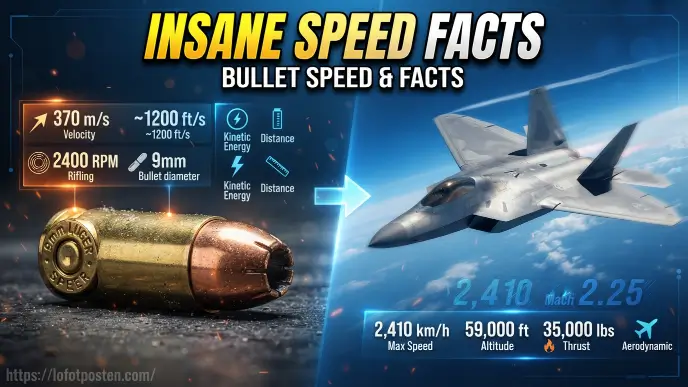
When discussing how fast a bullet travels, many people wonder how its speed compares to the speed of sound. At sea level and under normal atmospheric conditions, sound travels at approximately 1,125 feet per second (343 meters per second). Some bullets travel below this speed, while many modern rifle rounds exceed it by a significant margin. Whether a bullet is subsonic or supersonic affects its flight characteristics, bullet velocity, noise level, and overall ballistics. Understanding these categories helps explain why different types of ammunition perform differently in various shooting applications.
Subsonic Bullets
Subsonic bullets are projectiles that travel at speeds below the speed of sound, generally less than 1,125 feet per second under standard conditions. These bullets are commonly used in specialized ammunition designed to reduce noise, as they do not create the loud shock wave associated with breaking the sound barrier. Certain handgun cartridges and some rifle loads are intentionally manufactured to remain subsonic for specific sporting and recreational purposes.
When considering how fast a bullet travels, it’s important to note that subsonic bullets typically produce lower muzzle velocity than supersonic rounds. Although they travel more slowly, they can still be highly accurate, especially over shorter distances. Their reduced speed also minimizes aerodynamic disturbances caused by transitioning through the sound barrier, making them suitable for applications where consistent projectile speed is desirable.
Supersonic Bullets
Supersonic bullets travel faster than the speed of sound, which means they exceed approximately 1,125 feet per second under normal atmospheric conditions. Most modern rifle cartridges fall into this category, with many achieving bullet velocity between 2,500 and 3,500 feet per second. Their high speed allows them to cover long distances in a very short amount of time while maintaining relatively flat trajectories.
For those asking how fast does a bullet travel, supersonic ammunition provides the answer most commonly associated with high-powered firearms. These bullets retain significant speed immediately after leaving the barrel, although air resistance gradually slows them during flight. Their high projectile speed makes them effective for many sporting and hunting applications, but they also produce a distinctive sound as they move faster than the speed of sound.
Why Sonic Crack Happens
The sonic crack is the sharp, snapping sound produced when a bullet travels faster than the speed of sound. As a supersonic bullet moves through the air, it compresses air molecules faster than the sound waves can spread. This creates a pressure wave, known as a shock wave, that follows the bullet throughout its flight. When this shock wave reaches an observer, it is heard as the familiar cracking noise.
Understanding the sonic crack helps explain another aspect of how fast does a bullet travel. The sound is not caused by the firearm itself but by the bullet’s supersonic movement through the atmosphere. Once the bullet slows below the speed of sound, the shock wave disappears because it is no longer traveling faster than the surrounding sound waves. This phenomenon is a fundamental concept in ballistics and illustrates the close relationship between bullet velocity and the physics of sound.
Which Bullets Travel the Fastest?
When discussing how fast does a bullet travel, it’s natural to wonder which bullets achieve the highest speeds. In general, high-velocity rifle cartridges are the fastest, often exceeding 3,500 feet per second (fps) due to their powerful powder charges, lightweight bullets, and aerodynamic designs. Factors such as caliber, bullet weight, barrel length, and ballistic coefficient all contribute to maximum bullet velocity. While many sporting and hunting rifles are designed for exceptional projectile speed, specialized cartridges developed for long-range accuracy and varmint hunting are among the fastest commercially available.
Bullets Travel
- The .220 Swift is widely recognized as one of the fastest commercial rifle cartridges, exceeding 4,000 feet per second.
- The .22-250 Remington delivers exceptional bullet velocity with lightweight bullets designed for long-range precision and accuracy.
- The .204 Ruger combines small caliber with high velocity, making it popular for varmint and target shooting.
- The .17 Remington achieves remarkable projectile speed using lightweight bullets and carefully engineered high-performance ammunition.
- The .223 Remington offers impressive speed while maintaining reliable accuracy for sporting and recreational shooting applications.
- The 5.56 NATO cartridge provides high velocity and consistent performance across a variety of compatible rifle platforms.
- Lightweight bullets generally travel faster than heavier bullets because they require less energy to accelerate through the barrel.
- Longer rifle barrels often increase muzzle velocity by allowing expanding gases to propel bullets for a greater distance.
- Bullets with a high ballistic coefficient retain speed more efficiently by reducing aerodynamic drag during flight.
- Although speed matters, choosing the right ammunition depends on accuracy, intended use, and firearm compatibility rather than velocity alone.
Does a Bullet Slow Down After Leaving the Barrel?
A common question people ask after learning how fast a bullet travel is whether a bullet maintains the same speed throughout its flight. The simple answer is no. A bullet reaches its highest muzzle velocity the moment it exits the barrel, but it immediately begins slowing down due to several natural forces. Factors such as air resistance, gravity, and energy loss continuously reduce bullet velocity as the bullet travels farther from the firearm. Understanding these forces is an important part of ballistics because they affect a bullet’s trajectory, accuracy, and overall projectile speed over distance.
Air Drag
Air drag, also known as aerodynamic drag, is the primary reason a bullet slows down after leaving the barrel. As the bullet moves through the air, it collides with countless air molecules that create resistance against its forward motion. This resistance continuously reduces the bullet’s projectile speed, and the effect becomes more noticeable as the bullet travels greater distances. Bullets with streamlined shapes and a higher ballistic coefficient experience less drag, allowing them to retain velocity more efficiently.
The amount of drag affecting a bullet depends on several factors, including its shape, weight, speed, and environmental conditions. Even though a bullet may leave the barrel at extremely high muzzle velocity, air resistance begins acting on it immediately. This explains why how fast does a bullet travels cannot be answered with a single fixed number, as the speed constantly changes throughout the bullet’s flight.
Gravity
Gravity also influences a bullet as soon as it leaves the firearm, although its effect differs from that of air drag. Instead of directly reducing bullet velocity, gravity continuously pulls the bullet downward toward the ground. This downward force causes the bullet’s trajectory to curve over distance, which is why bullets do not travel in perfectly straight lines.
While gravity mainly affects the bullet’s vertical movement, it works together with air resistance to change the bullet’s overall flight path. The longer a bullet remains in the air, the more time gravity has to act upon it. When studying how fast does a bullet travel, it is important to understand that speed and trajectory are closely connected, and both are fundamental concepts in ballistics.
Energy Loss Over Distance
As a bullet travels farther from the muzzle, it gradually loses kinetic energy because its projectile speed decreases. Since kinetic energy depends largely on velocity, even a modest reduction in speed results in a noticeable decrease in the bullet’s energy. This is why manufacturers and researchers often measure bullet velocity at various distances instead of relying solely on muzzle velocity.
For example, imagine a rifle bullet leaving the barrel at approximately 3,000 feet per second. After traveling several hundred yards, air resistance has slowed the bullet, reducing both its speed and energy compared to when it was first fired. This simple example illustrates why how fast a bullet travels depends not only on the type of ammunition used but also on how far the bullet has traveled from the firearm.
Common Myths About Bullet Speed
There are many misconceptions surrounding how fast does a bullet travel, largely because bullet performance depends on numerous factors rather than a single measurement. Movies, television, and popular media often oversimplify how bullets behave in flight, leading to misunderstandings about bullet velocity, muzzle velocity, and ballistics. In reality, every type of ammunition performs differently based on its design, caliber, and environmental conditions. Understanding the facts behind these common myths helps provide a more accurate picture of how bullet speed really works.
Bullets Travel at One Constant Speed
One of the most common myths is that a bullet maintains the same speed from the moment it leaves the firearm until it reaches its destination. In reality, a bullet achieves its highest muzzle velocity as it exits the barrel and immediately begins slowing due to air resistance. As it travels farther, aerodynamic drag continuously reduces its bullet velocity, meaning the bullet is constantly changing speed throughout its flight.
This is why how fast does a bullet travel cannot be answered with a single fixed number. Ballistics experts measure bullet speed at different distances because the projectile speed decreases over time. Modern testing equipment demonstrates that every bullet gradually loses velocity after leaving the barrel, regardless of the firearm or cartridge used.
Bigger Bullets Are Always Faster
Another widespread misconception is that larger bullets automatically travel faster than smaller ones. While bigger bullets may appear more powerful, their size alone does not determine bullet velocity. In many cases, smaller and lighter bullets accelerate more quickly because they require less energy to move, allowing certain cartridges to achieve much higher speeds.
When evaluating how fast does a bullet travel, factors such as caliber, bullet weight, cartridge design, barrel length, and powder charge are all more important than bullet diameter alone. Some small-caliber rifle cartridges are among the fastest commercially available, while many larger bullets travel at considerably lower velocities.
All Bullets Exceed the Speed of Sound
Many people assume every bullet travels faster than sound, but this is not true. While numerous rifle cartridges are supersonic, many handgun rounds and specialized ammunition are intentionally designed to remain subsonic. These bullets travel below the speed of sound and therefore do not produce the characteristic sonic crack associated with faster projectiles.
Understanding how fast does a bullet travel requires recognizing the difference between subsonic and supersonic ammunition. Whether a bullet exceeds the speed of sound depends entirely on its design, intended purpose, and muzzle velocity, not simply on the fact that it has been fired from a firearm.
Bullet Speed Equals Stopping Power
A common myth is that higher bullet velocity automatically means greater stopping power. Although speed contributes to the amount of kinetic energy a bullet carries, it is only one part of overall bullet performance. Factors such as bullet construction, weight, caliber, shot placement, and intended application also influence how a projectile performs.
When discussing how fast does a bullet travel, it is important not to confuse speed with effectiveness. Engineers evaluate ballistics using multiple measurements rather than velocity alone, because real-world performance depends on the interaction of several characteristics. This is why different types of ammunition are designed for different purposes instead of simply maximizing speed.
Practical Examples of Bullet Speed
Understanding how fast does a bullet travel becomes much easier when looking at real-world examples. Different firearms and cartridges produce varying levels of bullet velocity based on their design, caliber, barrel length, and the type of ammunition used. While handguns generally fire bullets at moderate speeds, rifles are capable of achieving much higher projectile speeds because of their larger powder charges and longer barrels. The table below compares the average muzzle velocities of several common cartridges, providing a practical reference for understanding how bullet speed varies across different firearm types.
| Cartridge | Common Firearm Type | Average Muzzle Velocity (fps) | Approximate Speed (mph) |
| .22 LR | Rimfire Rifle/Pistol | 1,000–1,300 | 682–886 |
| 9mm Luger | Handgun | 1,100–1,250 | 750–852 |
| .45 ACP | Handgun | 830–950 | 566–648 |
| .357 Magnum | Revolver | 1,200–1,500 | 818–1,023 |
| 5.56 NATO | Sporting Rifle | 2,900–3,200 | 1,977–2,182 |
| .223 Remington | Sporting Rifle | 3,000–3,300 | 2,045–2,250 |
| .308 Winchester | Hunting Rifle | 2,600–2,900 | 1,773–1,977 |
| .30-06 Springfield | Hunting Rifle | 2,700–3,000 | 1,841–2,045 |
| .22-250 Remington | High-Velocity Rifle | 3,600–4,000 | 2,455–2,727 |
| .220 Swift | High-Velocity Rifle | 3,900–4,200 | 2,659–2,864 |
Note: These figures represent average muzzle velocity using standard factory ammunition. Actual bullet velocity may vary depending on barrel length, bullet weight, firearm design, environmental conditions, and manufacturer specifications.
Safety and Why Bullet Velocity Matters
Understanding how fast does a bullet travel is valuable because bullet velocity influences many fields beyond simple curiosity. The speed of a bullet affects its trajectory, energy, and behavior in flight, making it an important concept in ballistics. Professionals involved in hunting, competitive shooting, forensic science, and physics education all rely on accurate knowledge of muzzle velocity and projectile speed. By understanding how velocity changes under different conditions, people can better appreciate the science behind firearms while promoting responsible handling, informed decision-making, and safe educational practices.
- Hunting requires understanding bullet velocity to predict trajectory and achieve consistent accuracy while selecting appropriate ammunition for ethical harvesting.
- Faster bullets generally produce flatter trajectories, helping hunters estimate bullet drop more accurately across varying shooting distances in the field.
- Competitive shooting depends on consistent muzzle velocity to improve precision, repeatability, and overall shooting performance during organized events.
- Match-grade ammunition is carefully manufactured to deliver uniform bullet velocity for enhanced consistency and reliable target accuracy.
- Forensic investigators analyze bullet velocity and ballistics to better understand projectile movement during evidence reconstruction and scientific investigations.
- Scientific ballistics testing helps experts compare different firearms, cartridges, and environmental conditions using measurable projectile performance data.
- Physics education uses how fast does a bullet travel to explain motion, momentum, kinetic energy, and aerodynamic principles through practical examples.
- Students learn how gravity and air resistance influence projectile speed and cause bullets to slow throughout their flight path.
- Understanding muzzle velocity helps separate common myths from scientific facts about firearm performance and projectile behavior.
- Learning firearm science encourages responsible safety awareness while improving knowledge of ballistics, projectile motion, and modern ammunition technology.
Frequently Asked Questions
How fast does a 9mm bullet travel?
A 9mm bullet typically travels between 1,100 and 1,250 feet per second (fps). The exact bullet velocity depends on the firearm, barrel length, and ammunition used.
Are all bullets faster than the speed of sound?
No. Some subsonic ammunition travels below the speed of sound, while most rifle bullets are supersonic and exceed it.
What is the fastest commercial bullet?
The .220 Swift is one of the fastest commercial cartridges, capable of exceeding 4,000 fps. It is known for its extremely high muzzle velocity.
Why do bullets slow down after leaving the barrel?
Bullets lose speed because air resistance creates drag during flight. Gravity also affects the bullet’s path over longer distances.
How is bullet speed measured?
Manufacturers measure bullet velocity using a chronograph or advanced ballistic testing equipment. These tools provide accurate speed measurements as the bullet travels.
Conclusion
Understanding how fast does a bullet travels helps explain the science behind firearm performance and bullet velocity. As you’ve learned, bullet speed varies depending on factors such as caliber, barrel length, bullet weight, cartridge design, and environmental conditions. While handguns generally produce lower muzzle velocity, rifles can propel bullets at several times the speed of sound.
Knowing how bullet speed changes during flight also provides a better understanding of ballistics, projectile speed, and why different types of ammunition perform differently. Whether you’re learning for educational purposes, physics, hunting, competitive shooting, or forensic studies, understanding bullet velocity offers valuable insight into how bullets behave from the moment they leave the barrel until they reach their destination.
